
 |
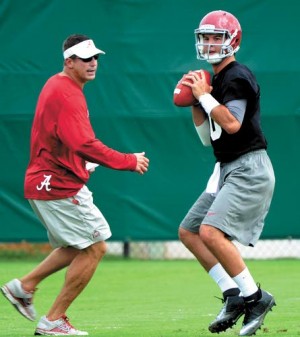
| Doug Nussmer works with A.J. McCarron at Alabama |
Hello,
Thank you for the great content on your site. I was thinking recently about position coaches, especially with the happenings at Michigan regarding our new OC/QB coach and speculation about the OL coach and how long Fred Jackson may stay on. There's always a grass is greener attitude among fanbases, and Michigan is no exception. Your honesty is probably the least susceptible to this way of thinking, which is refreshing. In this regard, I was thinking it might be a good piece for your blog to discuss the relative importance of each position coach. For instance, on average which is better to have for developing players--a good RB coach or a good OL coach? Is the RB position naturally more about athleticism and instinct, and so only so much can be taught? Is it the opposite? A rank-order list of all position coaches (+ coordinators maybe?) with explanations would be interesting.
This might help frame the discussion about hiring/firing coaches, helping to give a sense of the net gain/loss of a particular staff member. I would assume this would be based mostly on your experience in coaching, and thus subjective, but I still think it would be a valuable piece. Just my 2 cents, keep up the good work!
Thanks, MattFirst of all, thanks for the compliments, and thanks for reading. I wish I could you a more definitive answer, but unfortunately, your question dips its toes into a bit of a gray area. As with any work place or administrative team, I think it's good to mix and match personalities and strengths. For example, a bunch of screamers and drill sergeants might not get the best out of the guys who take to more positive feedback. Having a group of 10 "players coaches" leaves room for the guys on the team to take advantage of the men who are their leaders. By the same token, some guys who are brilliant tacticians might not be great teachers. Personally, I work with one guy who's inexperienced and doesn't understand a whole lot about football concepts, but he's a motivator who gets his players excited and competitive. Obviously, almost every guy who coaches at the FBS level is going to have a good grasp of football, although they're clearly not all geniuses. You also have to be concerned about their ability to recruit, their ability to set a good example, etc. So there's a lot that goes into coaching besides X's and O's.
As for your specific question about whether a good developer of talent is more necessary at offensive line or running back, I think the offensive line coach is clearly more important. Not only is he responsible for five guys up front (and the backups), but a poor offensive line can submarine an offense and consequently a team. There are some finer points of teaching running backs that a lot of people don't realize, but a running back can get by on a fair number of plays with sheer talent. That's why freshman running backs step in frequently and have success. For example, a running back on an outside zone play has some minor footwork assignments and is told to aim two yards outside the tight end or tackle; after that it's all about eluding the guys in the opposite colored jersey. Meanwhile, his offensive linemen have the same footwork assignments, but they have pre-snap reads, angles, hand placements, combo blocks, etc. throughout the outside zone play. Aside from the quarterback position, I believe offensive line is the toughest position to coach and learn.
I'll take a stab at ranking the importance of each coach, although I'm going to operate by ranking the coordinators as separate entities from position coaches:
- Head coach: Everything comes downhill, good or bad. He's the one who's the face of the program and sets the tone for his coaches and players. This is probably obvious.
- Defensive coordinator: A shoddy defense can really take the wind out of any team's sails. Although we've seen each side let down the other in recent years (Rodriguez's defense let down the offense, Borges's offense let down the defense), I think it's demoralizing for the team and the fans in the stadium when your defenders can't get off the field. If your defense gets the job done, a big play or two might help win a game even when the offense is stumbling.
- Offensive coordinator: The biggest thing for an offensive coordinator, in my opinion, is to utilize his personnel properly. In Michigan's case, I don't think Al Borges got the best out of Denard Robinson or Devin Gardner, even though the latter set some passing and total offense records. I also don't think Borges's offense was coherent enough to fit Michigan's offensive line. Teams can be successful with simplified offenses, as long as they know how to execute against any front, coverage, blitz, etc.
- Quarterback coach: Quarterback is the most important position on the field. Therefore, the guy needs the best tutelage he can possibly receive. Turnovers, incompletions, miscommunication, etc. can all undermine an offense's goal and a team's confidence. Conversely, good quarterback play can elevate and inspire a team.
- Offensive line coach: As mentioned above, I believe the offensive line is the second-most difficult position group to coach. Along with having to coach five positions, each player has his own unique strengths, weaknesses, footwork, stance, reads, etc. Even if you have great skill players, you can't win if you can't block up front, because the ball can't get distribute properly.
- Linebacker coach: This is a very difficult choice here between the linebackers and defensive linemen, but linebacker is a very technical position, and one false step or bad read can be the difference between no gain or a huge gain. Linebackers also have the somewhat unique responsibility of being involved in the run and the pass. One of the linebackers (usually the MIKE) is typically the captain or field general of the defense, and he has to make sure that all the guys in the front seven are on the same page.
- Defensive line coach: Going along with what I said about the defensive coordinator, a poor defense can spell disaster for the team. I don't think you have to have a ton of playmakers on the defensive line, but you have to have guys who can do their job adequately so the linebackers and defensive backs can do their own thing without having to cover up for the line's deficiencies. Much like the offensive line, you can win or lose an individual battle with a slightly different hand placement, stepping two inches shorter or farther, stepping at a 45' angle instead of a 90' angle, etc.
- Defensive back coach: Some guys in the secondary can get by on pure athleticism, but a lot of guys have to understand route combinations, splits, formations, etc. I think technique with cornerbacks can be pretty easy to teach because those guys are so coordinated and fluid in the first place, but the mental aspect can give those guys the edge they need to make a difference between a short completion and a pass breakup, a pass breakup and a pick, etc.
- Running back coach: While the running back position seems easy to play, there are a lot of things that good running backs do to help out a quarterback and an offense. Awareness of the blitz, knowing how the linebackers are going to flow, etc. can help in the passing game.
- Wide receiver coach: The wide receiver position is so much about athleticism that I don't think they need a lot of deep thought from a coach. There are lots of little techniques that can be taught (stance, release, body positioning, etc.), but much like cornerbacks, they're typically smooth and coordinated enough to pick up on those things easily. I also think drills and such are easier to watch and correct in one-on-one or skelly situations during practice, whereas on the offensive line, the whole unit needs to be cohesive.
- Tight end coach: I think tight end is probably the easiest position to play or coach at a high level, provided you have the size, athleticism, strength, speed, etc. to do so. Just due to their alignment on the field, they either block down or arc release in the run game or they run pretty simple routes in the passing game (hitch, drag, seam, etc.). There are some finer nuances, like in the zone run game or if they split out wide, but generally, there are a finite number of techniques and a small number of guys to coach.
I hope this helps answer your questions. I've never really thought about the topic before, so it's a fresh idea to me, too.


