Showing posts with label Doug Nussmeier. Show all posts

Sunday, May 3, 2015

Ex-Wolverine Updates

Josh Furman (right) became a seventh round draft pick at Oklahoma State
Thanks to David for the recent donation! If you would also like to donate to the site redesign drive, please use Paypal (on the left sidebar) or do some shopping on Amazon (LINK). Thanks!
---------------

The NFL Draft is over and guys are signing undrafted free agent contracts, so it's time for another ex-Wolverine update. I'm also including the fates of a few coaches, in case you're wondering what some of those guys up to these days.

Former offensive coordinator Al Borges: Borges has been hired as San Jose State's offensive coordinator (LINK). He joins former Michigan defensive coordinator Greg Robinson, who is SJSU's defensive coordinator.

Former offensive line coach Darrell Funk: Funk has been hired as Akron's offensive line coach (LINK).

Former safety Josh Furman: Furman, who spent his fifth year senior season playing linebacker at Oklahoma State, was drafted in the seventh round by the Denver Broncos (LINK).

Hit the jump for more ex-Wolverines, including a list of the fates of all 27 players from the 2010 class.

Thursday, December 4, 2014

Poll results: Which coach(es) should be retained beyond 2014?

Roy Manning (image via Maizeandbluenews.com)
Leading up to last week's game against Ohio State, I asked a question about which coach(es) should be retained after the season. Voters were allowed to pick multiple answers. Here are the results:

Roy Manning (cornerbacks): 51%

Greg Mattison (defensive coordinator/linebackers): 49%

Doug Nussmeier (offensive coordinator/quarterbacks): 18%

Mark Smith (defensive line): 18%

Fred Jackson (running backs): 7%

Dan Ferrigno (tight ends): 5%

Curt Mallory (safeties): 4%

Jeff Hecklinski (wide receivers/recruiting coordinator): 3%

Darrell Funk (offensive line): 2%

Brady Hoke (head coach): 0% (1 vote)

No coaches should be retained: 18%

Hoke has been canned, and defensive coordinator Greg Mattison reportedly cleared out his desk upon learning the news. So the 49% of people who wanted him back will be disappointed, and the one lonely soul who wanted Hoke to return is drinking a beer by himself. The other staff members could possibly be interviewed and retained, but it's unusual to keep on more than one or two guys from a previous regime.

Sunday, October 5, 2014

Rutgers 26, Michigan 24

Devin Gardner (image via Zimbio)
The referees were kind of terrible. The best (or worst) example of this was late in the fourth quarter. Michigan finally used a half-roll - which I've been calling for all year - to get quarterback Devin Gardner away from pressure, and he hit Amara Darboh near the sideline. Darboh took two steps  with the ball in his possession, turned forward to stretch the ball across the first down marker, dove, lost control of the ball just before he hit the ground, and the pass was called incomplete. A review didn't come from the booth, so Michigan finally called a timeout. It was challenged, they went back to look at it, and the officials didn't even say the play "stands" - they said the call was "confirmed." Add to that a clear pass interference call they missed on a key third down when Jehu Chesson was hip-checked to the ground, plus a non-call against Jake Ryan, and a couple other iffy calls, and the refs were just bad. They were bad both ways, but at the most critical time, on a reviewable play, they botched the call terribly.

Jeremy Clark is not an answer. I've been wanting to say this for a few weeks, but for whatever reason, I've held off. Clark's lack of field awareness has hurt Michigan numerous times this season, and this time he cost Michigan an 80-yard touchdown pass. I don't really understand why the coaching staff makes him the deep safety because he's not a guy who makes plays in space. I will grant that he has decent speed, but it doesn't matter much if he's often out of position. The more experienced player, Jarrod Wilson, should be back there. The plays Clark has made this year have been tackling in the run game and pass coverage in the flats. He has not made a single impressive play from the deep safety position. He takes poor angles, gets caught flat-footed, doesn't properly recognize route combinations, etc. It's extremely frustrating that the coaches appear not to have a better answer yet.

The presence of Devin Gardner infuriates me. Granted, he makes at least one bonehead play a week, but he should have been the starter last week against Minnesota in a winnable game. This week's bad decision was a ball he lofted into the middle of the field with nobody but a Rutgers safety anywhere near the ball, except perhaps Devin Funchess, who was running up the left sideline. Otherwise, Gardner was 13/22 overall for 178 yards. His feet were a huge part of keeping drives alive and scoring touchdowns. The national leaders in sacks got him 3 times for -18 yards, but he ran 7 other times for 58 yards, including 2 touchdowns. He has enough arm strength to make all the throws in college, and he has some chemistry with a few Michigan receivers - Devin Funchess, Jake Butt, Amara Darboh, even Dennis Norfleet. Shane Morris, meanwhile, has yet to throw a touchdown pass and has shown no discernible chemistry with even a single receiver. I'm not saying that Michigan would have beaten the Gophers, but he would have given them a chance.

Don't let other "analysts" fool you about Gardner's abilities from under center. I have read numerous times that Gardner should not be taking snaps from under center, that Michigan's waggle is a disaster waiting to happen, that playing from under center takes away his running ability, etc. All of that is bull. First of all, this is Doug Nussmeier's offense. Just like Rich Rodriguez could not be expected to run a pro-style offense, we shouldn't expect Nussmeier to run a shotgun-only offense with all kinds of power reads, inside zone reads, midline reads, etc. Second, Gardner on a waggle or bootleg generally puts him in space with a player who is physically overmatched. I don't see how people watch things like Gardner's two touchdown runs in this game, and then walk away concluding that Gardner can't use his legs in this offense. People who say stuff like that are enamored with shotgun spread offenses, and in my opinion, their comments are being colored by an agenda rather than football knowledge.

Stop holding. I mean, come on, guys. Is this so difficult? Michigan took two holding penalties - by Mason Cole and Kyle Kalis - that put them behind the sticks. Why did they have to hold? They stopped moving their feet. If they keep moving their feet and working their hips around to the playside, then they wouldn't have to grab jersey. The holding call on Kalis was especially egregious on his part. I would think the son of an NFL lineman would know better by now. I don't know if it's coaching, stupidity, laziness, or a combination of all those things. There aren't many teams who can overcome 1st-and-20 or 2nd-and-20.

Has Michigan found a running game? It seemed like things started clicking in the fourth quarter, or maybe it was just Rutgers getting worn down. Either way, the Wolverines started having some consistent success in the running game, especially over the left side. Last week Derrick Green had a poor game, while De'Veon Smith had one good drive. This week it was Green's turn. He carried 12 times for 74 yards (6.2 yards/carry), and while he left some yards on the field by getting ankle-tackled, it was a solid night for him overall. Michigan actually out-rushed Rutgers by a wide margin (158 to 74).

Play action passing game improvements. Michigan had some success with inside zone runs out of the shotgun, and that helped set up some play action. It seems like Michigan has honed its backfield action to include a more believable mesh between quarterback and running back. I think that paid some dividends tonight, and it should going forward as well. That's a small detail, but I think it indicates some growth in the offense. Rutgers doesn't have a great defense, but Michigan looked better than they did against Notre Dame, Utah, or Minnesota. I still have faith in offensive coordinator Doug Nussmeier that he can improve this offense. Unfortunately, it appears he may not get a chance to see it all the way through with Brady Hoke likely getting fired by/at the end of the season.

Why was Rutgers able to pass the ball so well? Most importantly to answer this question, Michigan does not have a consistent pass rush. A few times on the evening, they quickly got in the backfield - a Frank Clark rush from middle linebacker, a Willie Henry dismantling of the offensive line, a TE stunt by Taco Charlton, etc. The problem is that when Michigan didn't slice cleanly through the offensive line, they couldn't disengage quickly enough to put pressure on Rutgers quarterback Gary Nova. It's all or nothing. Meanwhile, Jeremy Clark is unfit to play his position, Delano Hill has been injured most of the season, and Jabrill Peppers has mostly been sidelined for one reason or another. Michigan is missing two of its five starters in the defensive backfield (Peppers, Hill), a third starter is very weak (Clark), and a lack of a pass rush hurts. You also have to tip your hat to Nova and company, who made some nice plays on the evening.

Can Michigan beat anyone left on the schedule? Yes. Penn State, Northwestern, and Maryland are all possibilities. I think Michigan State, Ohio State, and Indiana are all looking very unlikely. It's obviously a steep uphill climb to reach bowl eligibility at 2-4.

Sunday, September 21, 2014

Utah 26, Michigan 10

This is a sad sight in so many ways.
Shane Morris is no better than Devin Gardner. There is a large contingent of fans who always think the grass is greener on the other side of the fence. They clamored for Shane Morris, and they finally got him in the fourth quarter. What was the result? An interception, a fumble, and a sack. It's the difference between a Ford Explorer and a Mercury Mountaineer. Until Michigan can establish a consistent running game, pressure will be on the quarterbacks. And if the Wolverines can't find another solid receiving target outside of Devin Funchess, things are going to get even worse. When times get tough, the only thing Michigan does is script throws from Devin Gardner to Devin Funchess. Another receiver has to step up, the offensive line has to block better, and/or the running backs need to improve.

Willie Henry was your leading scorer. Michigan scored ten points altogether, with six coming on Henry's awesome interception return for a short touchdown. I like that Michigan is scoring some non-offensive touchdowns (Ben Gedeon returned a blocked punt for a touchdown against Appalachian State, remember), but it's sad that the defense scored more points than 4-star recruit Devin Gardner, Biletnikoff Award watch list receiver Devin Funchess, Rivals 5-star running back Derrick Green, and so on.

In some ways, Funchess hurt the team. The most glaring example of this was when Gardner threw a skinny post to Funchess in the second quarter. Perhaps because of a bum ankle or laziness or inexperience at playing the wide receiver position, Funchess threw one paw out to try to catch a slightly overthrown pass. He could have stuck out both hands, and some guys would have dove. Instead, the ball bounced up to safety Brian Blechen, who pulled it in for the interception (and a nice return, which was negated by a questionable block-in-the-back penalty). Less obviously, Gardner seems more democratic with the football when Funchess is not on the field. The favorite target becomes Amara Darboh, but Darboh's not so overwhelmingly athletic that Gardner thinks he can beat triple coverage. With Funchess on the sideline, Gardner has to scan the whole field and will throw to Darboh, Jehu Chesson, Dennis Norfleet, Jake Butt, Khalid Hill, anyone. I'm not suggesting that the 6'5", 230 lb. guy with the #1 jersey should stay off the field altogether, but his presence - especially when he's limping - makes Michigan more of a one-dimensional team than they should be. That's the coaches' job to sort out.

The defense played great overall. Some people might point to the way-too-easy touchdown by Dres Anderson or the 67-yard screen pass to Bubba Poole as reasons that the defense underachieved in this one, but I don't think that was the case at all. Sure, those were flubs, but those happen in every game. Anderson's touchdown was a blown coverage, seemingly at the hands of sophomore safety Dymonte Thomas. The screen pass to Poole was a great call by Utah offensive coordinator Dave Christensen - and a terrible play by redshirt sophomore safety Jeremy Clark. Clark had no idea what to do and got caught up in the wash of a couple offensive linemen releasing downfield, rather than trying to get on top of Poole's route to slow him down. Overall, though, Michigan held Utah to 286 total yards (6 more than they allowed to Notre Dame), one offensive touchdown, and 13 first downs. Utah averaged 2.2 yards/carry as a team, including just 3.7 yards/carry by the running backs. If you told me before the game that Michigan would hold Utah to just one offensive touchdown and four field goals, I would have taken it in a heartbeat.

Are injuries a problem? I feel like injuries are a problem. I know every team goes through injuries, but it seems that Michigan's star player(s) get hurt every year. Devin Funchess got hurt in the second game and was still limping around in this one with an ankle injury that may linger for a while. Starting tight end Jake Butt is playing less than the ideal number of snaps because of his ACL recovery. Jabrill Peppers got hurt in week one, missed the Notre Dame game, and seemed to disappear for a stretch this game. Starting cornerback Raymon Taylor got hurt against the Fighting Irish and has yet to return. Both guys who were presumed to start at safety - Jarrod Wilson and Delano Hill - have missed extended time due to injuries. "Starting" linebacker Desmond Morgan has missed the last couple games, too. I would not say that the Wolverines have been devastated by injuries, but they aren't at full speed, either.

Derrick Green, you are not Darren Sproles. You are a 220 lb. former high school offensive guard. Run like it. I like that you have learned to pick up your feet in traffic, and I like that you are improving your vision. What I do not like is you tiptoeing through a hole on a straight-ahead run, getting planted on your butt by cornerback Tevin Carter, or running out of bounds when you have the choice to truck a defensive back or two. They say discretion is the better part of valor, but they also say "More yards good, less yards bad."

Derrick Green, you might be Darren Sproles. After years of eschewing passes to anyone other than Vincent Smith, the tailbacks finally got a chance to be involved in the passing game. Derrick Green had 2 catches - including a one-hander - for 26 yards, and Justice Hayes had 2 for 25. I don't think Green has the ability to become the next Eric Metcalf or Larry Centers, but Doug Nussmeier showing a willingness to throw to the running backs might set up other plays in the future.

What's Devin Gardner's problem? If I knew how to fix Gardner, I wouldn't be writing this here blog post. But as a blogger, it's my job to pretend I know.

  1. Gardner has an inherent - or coached - fixation on whoever his favorite target is from year to year. In 2012 it was Jeremy Gallon. In 2013 it was Jeremy Gallon. This year it's Funchess. Gardner locks onto his favorite receiver too quickly, and he throws to him even when he's well covered. This results in some amazing catches that make us think Gardner, Gallon, and Funchess are awesome. It also leads to lots of interceptions.
  2. Gardner has played for two coordinators who don't understand him. Both Nussmeier and Al Borges call too many play action waggles because they like to run the ball with lots of people stacked inside. Meanwhile, Gardner turns his back to the defense without having a good understanding of what's going on behind him, and it cuts the field in half. He generally keeps the ball or dumps it over the head of the unfoolable outside contain man to a fullback or tight end in the flat. Michigan has I-formation or under center tendencies with a quarterback - in my opinion - who should be running a pro-style shotgun/pistol offense the majority of the time.
  3. Michigan has yet to develop a solid complementary receiver to Funchess. Darboh is not a great route runner. Jehu Chesson does not have great ball skills. Dennis Norfleet seems comfortable only on bubble screens and swing passes. Jake Butt has been hurt. In yesterday's game, the big-play guy for Utah was Dres Anderson, but quarterback Travis Wilson was just as comfortable going to possession guy Kenneth Scott on any given play.
  4. The offensive line and defensive coordinators are in his head. Much like what we expected, the interior offensive line has improved its pass protection and blitz pickups, but the young/inexperienced offensive tackles are barely treading water. If any defensive coordinator fails to run an edge blitz on a critical down, it's probably because he feels sorry for Ben Braden and Mason Cole. Gardner's internal clock is screwed up because of it, so he spooks early.
How about a spread punt? No? Okay. We didn't need to tackle that Kaelin Clay guy, anyway.

To all the people who looked sideways at me in Friday's preview: thppppppppppppppbt. Some of you automatically assumed that Michigan would blow out Utah, and I have no idea why. Yes, their oodles of points in the first two games came against crappy opponents, but Michigan scored 52 and 34 points against crappy opponents. Utah has a solid blitzing defense and a capable, fast-paced offense. I think a lot of fans are falling prey to the whole "This is Michigan" mindset without looking at what's happening between the lines.

Minnesota is a threat. Every team is a threat now. There are no "gimme" games on the schedule. Minnesota, Rutgers, Indiana, Northwestern, Maryland, they're all capable of beating Michigan. If you are not absolutely terrible on defense, Michigan might not be able to get into the red zone. I do think things will improve because I believe in Doug Nussmeier, and Devin Gardner improved throughout the 2013 season as well. Like the Notre Dame game, Michigan outgained the opponent (308 to 286) but couldn't find the consistency to put together a touchdown drive. At some point the plays will come together consistently enough to put offensive touchdowns on the board against decent teams, but if Brady Hoke wants to keep his job, it has to happen soon.

Sunday, September 7, 2014

Notre Dame 31, Michigan 0

Oh, how I long for a "pocket."
What just happened? I found this question reverberating around in my head from the second quarter onward. The scoreboard - whether it said 31-0 or 37-0 at the end - was not reflective of what this Michigan team can do, and it was not reflective of Notre Dame. Notre Dame has some good players, and so does Michigan. Notre Dame has some good coaches, and so does Michigan. Notre Dame was missing some people, and so was Michigan. Are Notre Dame's coaches, starters, and backups 31 points superior to Michigan's? Well, yeah, I guess they are. But I have no idea why. Michigan had 289 total yards to Notre Dame's 280. It wasn't that the Fighting Irish totally destroyed Michigan's offense, or that their offense ripped up the Wolverines' defense. They just made plays when they needed to make plays, a trait absent from Michigan for the last couple years.

This is where I jump on Doug Nussmeier. When it comes to play calling, I don't think Nussmeier helped quarterback Devin Gardner at all on Saturday night. Notre Dame realized early on - probably as early as last year - that if they blitzed relentlessly, they could either get to Gardner or at least pressure him into bad throws or mistakes. Instead of pulling out plays to ease the pressure, Nussmeier basically said, "At least one receiver is going to beat his one-on-one matchup, so you'd better find him with Jarron Jones or Sheldon Day in your face." Al Borges and Vincent Smith perfected the throwback screen. Al Borges and Jeremy Gallon perfected the throwback tunnel screen. Borges loved to run lead draws. Nussmeier's way of slowing down the rush was to run zone read play action. When the bubbles and quick throws stopped working, he never seemed to take the next step to ward off the blitz. I would have liked to see more sprintouts, half rolls, tunnel screens, etc. He just thought the offensive line would magically stop the overload blitzes. Michigan moved the ball in chunks because they won one-on-one matchups - Devin Funchess vs. Cody Riggs, Dennis Norfleet vs. Jaylon Smith, etc. - but this isn't Alabama, where he can count on his offensive linemen winning one-on-one matchups. I was afraid that, at some point, Nussmeier would fall victim to thinking that he could just count on being bigger, faster, and stronger than the opponent. I hope he came to realize the errors in that thought process in the aftermath of this game.

This offensive line isn't as bad as last year. Center Jack Miller was repeatedly shoved back into Devin Gardner's grill, and that's a problem. But not every team has a Jarron Jones. Mason Cole and Erik Magnuson had several communication issues on the left side, but that comes with the territory of starting a true freshman left tackle. Regardless of the numbers, I thought the offensive line looked closer to the one that opened up huge holes against Appalachian State than the one that soured the taste in our mouths in 2013. Michigan is not a team that can wear teams down by running the ball, but they should be able to run the ball enough to keep most defenses off balance.

Blake Countess looks uncomfortable. I don't think Countess is a wussy corner like Deion Sanders, but Countess does look awkward in press coverage. He is not physical at the line of scrimmage, and because he lets receivers get free releases, he's opening up his hips too quickly. That style does not jive with what we're seeing at the other corner in the form of Raymon Taylor/Jourdan Lewis. If Countess can't play press man like defensive coordinator Greg Mattison wants this year, then perhaps he should move into the slot, where his ability to bait quarterbacks would be more useful.

So much for that wealth of cornerbacks. One place I thought Michigan had the advantage going into this game was at corner, where Michigan's experienced and/or talented guys could win out against some inexperienced - but still talented - wideouts. Then I saw that Jabrill Peppers was on the sideline with his bum ankle, replaced by the lesser talented Delonte Hollowell. Then after the first defensive series, starter Raymon Taylor went to the locker room with an injury and never returned to the game. Just like that, Michigan was missing two of its top three corners. Hollowell was picked on repeatedly by Notre Dame. Jourdan Lewis picked up two pass interference penalties, at least one of which was highly questionable. The next guy in was Channing Stribling, who still looks a half-beat too slow for playing football against the big boys. I thought the numbers were leaning toward Michigan, with five Notre Dame academic fraud suspects off the field and a starting safety missing due to injury. However, those absences quickly started to even out with Peppers, Taylor, and tight end Jake Butt standing on the sideline.

But the linebackers looked good. After being unimpressive last week against Appalachian State, I thought starting linebackers Jake Ryan (11 tackles) and Joe Bolden (10 tackles) looked markedly better last night. They were reacting quicker, and they held a solid crew of running backs to 25 carries for 61 yards.

The refereeing was bad. The second pass interference penalty on Jourdan Lewis was hogwash, and it appears that Michigan is a step late in wanting to be all hands-on with their corners. That's soooo  2013. Somehow, Devin Funchess got hit early on a crossing route that resulted in an incomplete pass, but the officials kept their hankies in their pockets. There was also no reason for Notre Dame's Corey Robinson to be ruled down on the three-yard line when Stribling tackled him on a skinny post; the ball should have been placed at the 6" line. You can't blame the refs for a 31-point loss, but they certainly didn't help Michigan find any success early.

The announcing was bad. I hate hate hate watching games on NBC, because it's always a Notre Dame slurpfest. And while there weren't a lot of good things to say about Michigan last night, I don't remember color guy Mike Mayock saying many nice things about Michigan players. He said NFL scouts "love" Jake Ryan, and he complimented Devin Funchess's ability to be big. Otherwise, he fawned over Everett Golson, Cam McDaniel, Greg Bryant, Jaylon Smith, Jarron Jones, Sheldon Day, Cody Riggs, Will Fuller's speed (though not his hands), and even Notre Dame's quarterbacks coach. Thank goodness that by the time Michigan plays Notre Dame again in the distant future - the year 2000 - Mayock won't be around anymore.

Turnovers don't exist. Michigan has zero takeaways in two games.

I don't know where this team goes from here. This seems like a game that could make or break some teams. I don't think anyone was under the illusion that Michigan was going to win a national championship this year, but the shutout could fracture a locker room and make some people question whether this unit is going anywhere. Again, I look at how Michigan moved the ball at times, and I think it might just be an unhappy coincidence that the Wolverines didn't string together enough plays to create a couple scores. Notre Dame has a high-powered offense, and I predicted that they would score 31 points. We all knew they could march down the field and score. Michigan needs to regroup and get healthy next week against Miami, and moving forward, Nussmeier needs to open up his playbook against blitzing defenses to keep them out of Gardner's face.

Sunday, August 31, 2014

Michigan 52, Appalachian State 14

Devin Funchess had three of these touchdowns on the day (image via Fansided)
The Doug Nussmeier Effect: Quarterbacks. Yes, it was only newly minted FBS team Appalachian State, but starting quarterback Devin Gardner looked about as good as possible. He was 13/14 for 173 yards, 3 touchdowns, and 0 interceptions; he also ran 5 times for 9 yards. Best of all, he made good decisions and his only miss was a laser that fell harmlessly to the turf behind a crossing receiver. I think Nussmeier will use him more often as a runner as the game and situation dictate, but there's no need to get him banged up in a blowout against ASU. Backup Shane Morris (3/5, 37 yards, 1 interception) looked a little shaky, especially on a comeback throw that never should have been released and got picked off by an undercutting corner. That's now 0 touchdowns and 3 interceptions thrown in his career.

The Doug Nussmeier Effect: Running Game. Opponent caveats apply, but Michigan struggled early before quickly finding a rhythm. The combo blocks looked cleaner and the offensive line looked crisper than they did at almost any time last year. The running backs combined for 31 carries, 345 yards, and 3 touchdowns. The inside zone run seemed ineffective at times because Michigan couldn't get a great push. That's a Nussmeier favorite, so they will surely continue to work on that play. Interestingly, Michigan's revamped power play seems to have improved, even though that was a supposed staple of Al Borges's offense and not considered to be a Nussmeier specialty. Perhaps Appalachian State was surprised, or maybe Michigan just executed the power really well in game one.

The Doug Nussmeier Effect: Running Backs. I would have to go back and check to be sure, but it seemed like Michigan really struggled early when they tried to run inside zone. Derrick Green (15 carries, 170 yards, 1 touchdown) got the first series of snaps, and his vision has always been somewhat questionable; those carries did not go well. When he returned to the game, Nussmeier ran power with him. Green hit the hole hard and did well. Meanwhile, for whatever reason(s), De'Veon Smith (8 carries, 115 yards, 2 touchdowns) seemed to get a little better blocking on inside zone plays, and his vision paid off with some nice runs. Green is leaner and quicker than last year, and Smith is what we thought he was. When the offensive line opens holes, they are capable of making some things happen. Drake Johnson (3 carries, 28 yards), Justice Hayes (4 carries, 23 yards), and Wyatt Shallman (1 carry, 5 yards) got some run late in the game, but Green and Smith clearly seem to be the top two options.

Devin Funchess is wearing the #1 jersey. Funchess is the first Michigan player to wear the #1 jersey since Braylon Edwards in 2004. Brady Hoke said that Funchess asked to wear it, so perhaps that's the difference, but it seems odd to me that he was given the jersey while previous standout Jeremy Gallon was not. Gallon had the same number of catches (49) and more yards (829 to 748) in his redshirt junior year than Funchess as a sophomore, and you could tell he was in for a big year because of his connection with Gardner. Gallon, of course, ended up setting receiver records last year. Regardless, Funchess looked very good on Saturday (7 catches, 95 yards, 3 touchdowns) and has the talent to fill the shoulder pads of the #1 jersey.

At least nobody can say Michigan sold out. Because they didn't. The announced attendance was 106,811, which is the 252nd straight game of over 100,000 fans.

Freshman redshirts got burned. Reasonably this time! The only true freshmen to play in the game against Appalachian State were Freddy Canteen, Mason Cole, Bryan Mone, and Jabrill Peppers. This would be excellent news if it holds up, because that means Michigan can save some of its highly touted recruits all the way until they're 22 or 23 years old. I do believe that a couple more freshmen might play this season, especially weakside end Lawrence Marshall.

How 'bout that tight pass coverage? It was pretty tight. Michigan didn't make any picks, but they broke up three passes and came up to tackle well. Jourdan Lewis is as sticky as they come, and he's just a backup. I thought new safety Jeremy Clark looked pretty good in Delano Hill's absence.

How 'bout that defensive line? When it comes to the defensive line, I actually don't think we learned much. If the quarterback held the ball for longer than the play was designed for, he was usually getting hit. Fortunately for the Mountaineers, that wasn't often. Pretty much every defensive lineman bulled his way into the backfield based on sheer size and strength against an overmatched and small-ish offensive line. Appalachian State had some repeated success on their shotgun inside zone play, which also worked well for Indiana and some other teams last year. Michigan might have been able to stop it if there had been a point to do so. But really, if you're whooping a team's butt on the scoreboard and they want to run the ball to deplete the clock, there's not a huge incentive to sell out for stopping that play.

JABRILL PEPPERS. Peppers made 1 nice tackle, dove to make a fair catch on a punt, and returned 1 punt for 6 yards. Then he left the game with a bum ankle. It did not look serious, and Brady Hoke agrees with the first clause of this sentence. He should be back for next week.

The offensive line can't get any worse than last year. I agree. I really think last year's offensive line would have still struggled to churn out yards on the ground like they did in this game. Appalachian State nose tackle Tyson Fernandez (6'2", 330 lbs.) was a load in the middle, and defensive end Ronald Blair (6'4", 275 lbs.) didn't seem too shabby, either. Blair overpowered freshman left tackle Mason Cole on an inside move to sack Gardner, and defensive end Odawala Dada (6'0", 235 lbs.) successfully juked guard Kyle Kalis on his way to a quarterback hurry. Otherwise, it was rare to see an offensive lineman beaten cleanly. There were some frustrating stalemates, and there will be plenty more - along with outright whoopings - to come this year. Michigan's line never coagulated last year, but even if a little less talented, this group is going to be better.

Friday, February 21, 2014

Brady Hoke announces new coaching responsibilities

The football program announced new coaching responsibilities yesterday, and most of the changes come on defense, where nobody has the same responsibility he had last year. The only change on offense is the hiring of Doug Nussmeier to replace Al Borges's duties.

Head coach: Brady Hoke
Offensive coordinator, Quarterbacks: Doug Nussmeier
Running backs: Fred Jackson
Wide receivers: Jeff Hecklinski
Tight ends, Special teams: Dan Ferrigno
Offensive line: Darrell Funk
Defensive coordinator, Linebackers: Greg Mattison
Defensive line: Mark Smith
Cornerbacks: Roy Manning
Safeties: Curt Mallory
Offensive grad assistant (tight ends): Kevin Koger
Offensive grad assistant (offensive line): Michael Switzer
Defensive grad assistant (defensive line): Ernie Lawson
Defensive grad assistant (linebackers): Jerry Milling

Thursday, January 23, 2014

Mailbag: How important is each position coach?

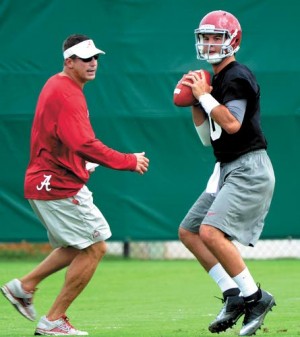
Doug Nussmer works with A.J. McCarron at Alabama

Hello, 
Thank you for the great content on your site. I was thinking recently about position coaches, especially with the happenings at Michigan regarding our new OC/QB coach and speculation about the OL coach and how long Fred Jackson may stay on. There's always a grass is greener attitude among fanbases, and Michigan is no exception. Your honesty is probably the least susceptible to this way of thinking, which is refreshing. In this regard, I was thinking it might be a good piece for your blog to discuss the relative importance of each position coach. For instance, on average which is better to have for developing players--a good RB coach or a good OL coach? Is the RB position naturally more about athleticism and instinct, and so only so much can be taught? Is it the opposite? A rank-order list of all position coaches (+ coordinators maybe?) with explanations would be interesting. 
This might help frame the discussion about hiring/firing coaches, helping to give a sense of the net gain/loss of a particular staff member. I would assume this would be based mostly on your experience in coaching, and thus subjective, but I still think it would be a valuable piece. Just my 2 cents, keep up the good work! 
Thanks, Matt
 First of all, thanks for the compliments, and thanks for reading. I wish I could you a more definitive answer, but unfortunately, your question dips its toes into a bit of a gray area. As with any work place or administrative team, I think it's good to mix and match personalities and strengths. For example, a bunch of screamers and drill sergeants might not get the best out of the guys who take to more positive feedback. Having a group of 10 "players coaches" leaves room for the guys on the team to take advantage of the men who are their leaders. By the same token, some guys who are brilliant tacticians might not be great teachers. Personally, I work with one guy who's inexperienced and doesn't understand a whole lot about football concepts, but he's a motivator who gets his players excited and competitive. Obviously, almost every guy who coaches at the FBS level is going to have a good grasp of football, although they're clearly not all geniuses. You also have to be concerned about their ability to recruit, their ability to set a good example, etc. So there's a lot that goes into coaching besides X's and O's.

As for your specific question about whether a good developer of talent is more necessary at offensive line or running back, I think the offensive line coach is clearly more important. Not only is he responsible for five guys up front (and the backups), but a poor offensive line can submarine an offense and consequently a team. There are some finer points of teaching running backs that a lot of people don't realize, but a running back can get by on a fair number of plays with sheer talent. That's why freshman running backs step in frequently and have success. For example, a running back on an outside zone play has some minor footwork assignments and is told to aim two yards outside the tight end or tackle; after that it's all about eluding the guys in the opposite colored jersey. Meanwhile, his offensive linemen have the same footwork assignments, but they have pre-snap reads, angles, hand placements, combo blocks, etc. throughout the outside zone play. Aside from the quarterback position, I believe offensive line is the toughest position to coach and learn.

I'll take a stab at ranking the importance of each coach, although I'm going to operate by ranking the coordinators as separate entities from position coaches:

  1. Head coach: Everything comes downhill, good or bad. He's the one who's the face of the program and sets the tone for his coaches and players. This is probably obvious.
  2. Defensive coordinator: A shoddy defense can really take the wind out of any team's sails. Although we've seen each side let down the other in recent years (Rodriguez's defense let down the offense, Borges's offense let down the defense), I think it's demoralizing for the team and the fans in the stadium when your defenders can't get off the field. If your defense gets the job done, a big play or two might help win a game even when the offense is stumbling.
  3. Offensive coordinator: The biggest thing for an offensive coordinator, in my opinion, is to utilize his personnel properly. In Michigan's case, I don't think Al Borges got the best out of Denard Robinson or Devin Gardner, even though the latter set some passing and total offense records. I also don't think Borges's offense was coherent enough to fit Michigan's offensive line. Teams can be successful with simplified offenses, as long as they know how to execute against any front, coverage, blitz, etc.
  4. Quarterback coach: Quarterback is the most important position on the field. Therefore, the guy needs the best tutelage he can possibly receive. Turnovers, incompletions, miscommunication, etc. can all undermine an offense's goal and a team's confidence. Conversely, good quarterback play can elevate and inspire a team.
  5. Offensive line coach: As mentioned above, I believe the offensive line is the second-most difficult position group to coach. Along with having to coach five positions, each player has his own unique strengths, weaknesses, footwork, stance, reads, etc. Even if you have great skill players, you can't win if you can't block up front, because the ball can't get distribute properly.
  6. Linebacker coach: This is a very difficult choice here between the linebackers and defensive linemen, but linebacker is a very technical position, and one false step or bad read can be the difference between no gain or a huge gain. Linebackers also have the somewhat unique responsibility of being involved in the run and the pass. One of the linebackers (usually the MIKE) is typically the captain or field general of the defense, and he has to make sure that all the guys in the front seven are on the same page.
  7. Defensive line coach: Going along with what I said about the defensive coordinator, a poor defense can spell disaster for the team. I don't think you have to have a ton of playmakers on the defensive line, but you have to have guys who can do their job adequately so the linebackers and defensive backs can do their own thing without having to cover up for the line's deficiencies. Much like the offensive line, you can win or lose an individual battle with a slightly different hand placement, stepping two inches shorter or farther, stepping at a 45' angle instead of a 90' angle, etc.
  8. Defensive back coach: Some guys in the secondary can get by on pure athleticism, but a lot of guys have to understand route combinations, splits, formations, etc. I think technique with cornerbacks can be pretty easy to teach because those guys are so coordinated and fluid in the first place, but the mental aspect can give those guys the edge they need to make a difference between a short completion and a pass breakup, a pass breakup and a pick, etc.
  9. Running back coach: While the running back position seems easy to play, there are a lot of things that good running backs do to help out a quarterback and an offense. Awareness of the blitz, knowing how the linebackers are going to flow, etc. can help in the passing game. 
  10. Wide receiver coach: The wide receiver position is so much about athleticism that I don't think they need a lot of deep thought from a coach. There are lots of little techniques that can be taught (stance, release, body positioning, etc.), but much like cornerbacks, they're typically smooth and coordinated enough to pick up on those things easily. I also think drills and such are easier to watch and correct in one-on-one or skelly situations during practice, whereas on the offensive line, the whole unit needs to be cohesive.
  11. Tight end coach: I think tight end is probably the easiest position to play or coach at a high level, provided you have the size, athleticism, strength, speed, etc. to do so. Just due to their alignment on the field, they either block down or arc release in the run game or they run pretty simple routes in the passing game (hitch, drag, seam, etc.). There are some finer nuances, like in the zone run game or if they split out wide, but generally, there are a finite number of techniques and a small number of guys to coach.
I hope this helps answer your questions. I've never really thought about the topic before, so it's a fresh idea to me, too.

Sunday, January 19, 2014

Poll results: What grade would you give the hiring of offensive coordinator Doug Nussmeier?

New Michigan offensive coordinator Doug Nussmeier
This post doesn't really need much commentary on my end. I asked readers what grade they would give Michigan's hiring of Doug Nussmeier, and the vast majority give the hire an "A." For what it's worth, there were zero votes for "D" and then four votes for "F," so I have to imagine that a few Buckeye or Spartan trolls stumbled across the site. If those votes were from legitimate Michigan fans, I would be curious to know the reasoning.

A: 79%

B: 18%

C: 1%

D: 0%

F: 0%

Sunday, January 12, 2014

An Average Season Under Doug Nussmeier

Devin Gardner has gone from catching touchdown passes against Alabama to likely throwing them
for Alabama's offensive coordinator.
Every team is different, but I wanted to take a stab at what kind of production we can expect from new offensive coordinator Doug Nussmeier while he's here in Ann Arbor. I looked at his last five years, which he spent with Washington (2009-2011) and then Alabama (2012-2013). I then averaged those seasons together to come up with a rough estimate of what types of numbers the Wolverines will put up. The player listed with the projection is my early guess at the depth chart for this upcoming fall.

Quarterback (Jake Locker, Keith Price, AJ McCarron):
230/395, 2800 yards, 21 touchdowns, 11 interceptions
184/332, 2265 yards, 17 touchdowns, 9 interceptions
242/362, 3063 yards, 33 touchdowns, 11 interceptions
211/314, 2933 yards, 30 touchdowns, 3 interceptions
226/336, 3063 yards, 28 touchdowns, 7 interceptions
--------------------------------------------------------
2014 Devin Gardner projection: 219/348, 62.9%, 2825 yards, 26 touchdowns, 8 interceptions
2013 Devin Gardner stats: 208/345, 60.3%, 2960 yards, 21 touchdowns, 11 interceptions

Running Back #1 (Chris Polk, Eddie Lacy, T.J. Yeldon):
226 carries, 1113 yards, 5 touchdowns
260 carries, 1415 yards, 9 touchdowns
293 carries, 1488 yards, 12 touchdowns
204 carries, 1322 yards, 17 touchdowns
207 carries, 1235 yards, 14 touchdowns
--------------------------------------------------------
2014 Derrick Green projection: 238 carries, 1315 yards, 11 touchdowns
2013 Fitzgerald Toussaint stats: 185 carries, 648 yards, 13 touchdowns

Running Back #2 (Demitrius Bronson, Jesse Callier, T.J. Yeldon, Kenyan Drake):
19 carries, 89 yards, 0 touchdowns
77 carries, 433 yards, 0 touchdowns
47 carries, 260 yards, 1 touchdown
175 carries, 1108 yards, 12 touchdowns
92 carries, 694 yards, 8 touchdowns
--------------------------------------------------------
2014 De'Veon Smith projection: 82 carries, 517 yards, 4 touchdowns
2013 Derrick Green stats: 83 carries, 270 yards, 2 touchdowns

Wide Receiver #1 (Jermaine Kearse, Amari Cooper):
50 catches, 866 yards, 8 touchdowns
63 catches, 1005 yards, 12 touchdowns
47 catches, 699 yards, 7 touchdowns
58 catches, 999 yards, 11 touchdowns
45 catches, 736 yards, 4 touchdowns
--------------------------------------------------------
2014 Devin Funchess projection: 53 catches, 861 yards, 8 touchdowns
2013 Jeremy Gallon stats: 89 catches, 1373 yards, 9 touchdowns

Wide Receiver #2 (Devin Aguilar, D'Andre Goodwin, Kevin Norwood):
42 catches, 593 yards, 5 touchdowns
44 catches, 530 yards, 4 touchdowns
41 catches, 611 yards, 6 touchdowns
29 catches, 469 yards, 4 touchdowns
38 catches, 568 yards, 7 touchdowns
--------------------------------------------------------
2014 Jehu Chesson projection: 39 catches, 554 yards, 5 touchdowns
2013 Devin Funchess stats: 49 catches, 748 yards, 6 touchdowns

Wide Receiver #3 (James Johnson, Devin Aguilar, Kasen Williams, Kenny Bell, DeAndrew White):
39 catches, 422 yards, 3 touchdowns
28 catches, 352 yards, 2 touchdowns
36 catches, 427 yards, 6 touchdowns
17 catches, 431 yards, 3 touchdowns
32 catches, 534 yards, 4 touchdowns
----------------------------------------------------------
2014 Amara Darboh projection: 30 catches, 433 yards, 4 touchdowns
2013 Jehu Chesson stats: 15 catches, 221 yards, 1 touchdown

Tight End #1 (Kavario Middleton, Marlion Barnett, Austin Sefarian-Jenkins, Michael Williams, O.J. Howard):
26 catches, 257 yards, 3 touchdowns
4 catches, 31 yards, 0 touchdowns
41 catches, 538 yards, 6 touchdowns
24 catches, 183 yards, 4 touchdowns
14 catches, 269 yards, 2 touchdowns
----------------------------------------------------------
2014 Jake Butt projection: 22 catches, 256 yards, 3 touchdowns
2013 Jake Butt stats: 17 catches, 235 yards, 2 touchdowns

Tight End #2 (Chris Izbicki, Michael Hartvigson, Kelly Johnson, Brian Vogler):
3 catches, 7 yards, 1 touchdown
2 catches, 16 yards, 1 touchdown
8 catches, 30 yards, 1 touchdown
5 catches, 39 yards, 0 touchdowns
8 catches, 71 yards, 1 touchdown
-----------------------------------------------------------
2014 A.J. Williams projection: 5 catches, 33 yards, 1 touchdown
2013 A.J. Williams stats: 1 catch, 2 yards, 1 touchdown

Thursday, January 9, 2014

Who should be happy/sad about the Doug Nussmeier hire?

Could Shane Morris be the next A.J. McCarron?
THIS HIRE IS GOOD FOR . . . 
Fifth year senior quarterback Devin Gardner. Gardner has one final chance to show his stuff at quarterback, and I think Nussmeier will bring a more cohesive offense to Ann Arbor. Gardner can run out of the shotgun and pistol, and he's not bad throwing from under center. I expect Nussmeier to simplify Michigan's blocking schemes, which should help out the young linemen and the quarterback. The new offensive coordinator also likes to push the ball down the field (as did Al Borges), which suits Gardner well because he has a strong arm and throws a nice deep ball.

The offensive line. Michigan's young offensive line was terrible this past season, and it appears that Nussmeier may bring in a new offensive line coach to help him out. Whether coach Darrell Funk remains or not, I expect that Nussmeier will want a little more beef up front, and his coaching pedigree at Alabama suggests that he can help those guys achieve a new level of success.

Sophomore running backs Derrick Green and De'Veon Smith. Nussmeier utilized the inside zone game and zone sweeps to great effect at Alabama, which recruited Green out of high school. Both Green and Smith fit the role of good inside zone runners, because both of them are north-south runners capable of running through tackles. Green has the better speed of the two and would likely be more effective on the zone sweeps.

Sophomore quarterback Shane Morris and freshman quarterback Wilton Speight. Nussmeier has tutored numerous successful college quarterbacks (A.J. McCarron, Jake Locker, Drew Stanton, Jeff Smoker) and spent time with the St. Louis Rams under passing game guru Mike Martz. I can see Morris as a McCarron-like Game Manager Plus, a guy who can not only take care of the football and keep his team in the game, but make some downfield throws to really stress defenses.

Redshirt freshman H-backs Khalid Hill and Wyatt Shallman. Nussmeier likes to use his H-backs as lead blockers, wings, slot receivers, etc. Hill and Shallman appear to be good fits for this role, more so than the fullbacks who have been playing the past couple seasons.

THIS HIRE IS BAD FOR . . . 
Redshirt junior running back Justice Hayes. Nussmeier does not appear to be a fan of scatback types, at least not for featured roles. Hayes was reported to be moving to slot receiver, although he started Michigan's bowl game at running back. His chances of winning the running back job next year likely took a hit with this hire.

Junior fullback Sione Houma and redshirt junior fullback Joe Kerridge. Nussmeier is a proponent of a one-back offense and doesn't have a whole lot of use for true fullback types. The hire will almost certainly diminish their role in the offense, which was already more significant than it should have been based on Michigan's personnel and abilities.

Doug Nussmeier, Wolverine

Doug Nussmeier with A.J. McCarron
Offensive coordinator Al Borges's replacement is none other than Doug Nussmeier, who is leaving the same position at Alabama. Nussmeier was a college quarterback at Idaho under former Michigan State head coach John L. Smith and won the Walter Payton Award, which is given to the DI-AA/FCS Player of the Year. He was a 4th round pick in the 1993 NFL Draft by the New Orleans Saints but was used sparingly, throwing for 455 yards, 1 touchdown, and 4 interceptions. He went on to play with a couple teams in the CFL.

Here's a list of his most recent coaching stops and some notable players:

  • Michigan State quarterbacks, 2003-2005: Drew Stanton
  • St. Louis Rams quarterbacks, 2006-2007: Marc Bulger
  • Fresno State offensive coordinator, 2008: Ryan Matthews
  • Washington offensive coordinator, 2009-2011: Jake Locker, Keith Price
  • Alabama offensive coordinator, 2012-2013: A.J. McCarron, Eddie Lacy, T.J. Yeldon, Amara Cooper
There will be more to come on this here blog, but for now, Michigan fans should be pretty excited.