Showing posts with label Donovan Warren. Show all posts

Friday, July 17, 2015

Review of 2007 Recruiting: Cornerbacks

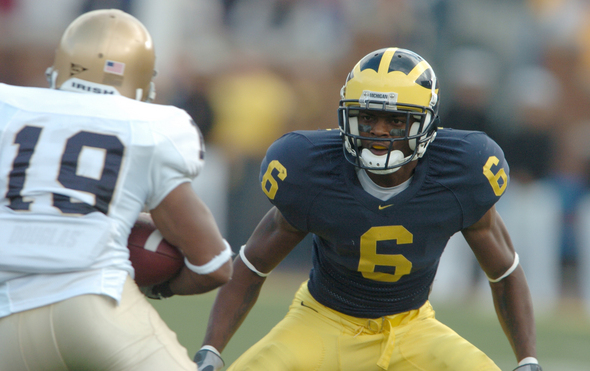
Donovan Warren
THE ROSTER
Doug Dutch, RS Jr.
Morgan Trent, RS Jr.
Brandon Harrison, Jr.
Zion Babb, RS Fr.

Hit the jump to see whom Michigan recruited and how they fared in their careers.

Tuesday, March 20, 2012

Michigan Combine participation and Draft position since 1999

Marquise Walker
With the NFL Combine behind us and the Draft not too far away, now seems like a good time to take a look at the recent history of Wolverines in the NFL. Here's a list of players who have participated in the combine since 1999, with draft position included in parentheses. It's worth remembering that the vast majority of players who are invited to the Combine end up with NFL teams, even if they are not selected in the Draft.

2012 (3): DT Mike Martin (TBD), WR Junior Hemingway (TBD), David Molk (TBD)

2011 (2): LB Jonas Mouton (2nd), Stephen Schilling (6th)

2010 (5): OLB Brandon Graham (1st), P Zoltan Mesko (5th), S Stevie Brown (7th)*, CB Donovan Warren (undrafted), RB Brandon Minor (undrafted)

2009 (4): DT Terrance Taylor (4th), CB Morgan Trent (6th), LS Sean Griffin (undrafted), DE Tim Jamison (undrafted)

2008 (7): OT Jake Long (1st), QB Chad Henne (2nd), LB Shawn Crable (3rd), WR Mario Manningham (3rd), RB Mike Hart (6th), WR Adrian Arrington (7th), SS Jamar Adams (undrafted)

2007 (6): CB Leon Hall (1st), DT Alan Branch (2nd), LB LaMarr Woodley (2nd), LB David Harris (2nd ), WR Steve Breaston (5th), LB Prescott Burgess (6th)

2006 (5): DT Gabe Watson (4th), WR Jason Avant (4th), TE Tim Massaquai (7th), OL Adam Stenavich (undrafted), LB Pierre Woods (undrafted)

2005 (7): WR Braylon Edwards (1st), CB Marlin Jackson (1st), OG David Bass (2nd), CB Markus Curry (undrafted), FB Kevin Dudley (undrafted), P Adam Finley (undrafted), S Earnest Shazor (undrafted)

2004 (5): RB Chris Perry (1st), CB Jeremy LeSueur (3rd), QB John Navarre (7th), OT Tony Pape (7th), OL David Pearson (undrafted)

2003 (7): LB Victor Hobson (2nd), TE Bennie Joppru (2nd), FB B.J. Askew (3rd), QB Drew Henson (6th), SS Cato June (6th), FS Charles Drake (7th), WR Ronald Bellamy (undrafted)

2002 (4): WR Marquise Walker (3rd), LB Larry Foote (4th), OG Jonathan Goodwin (5th), K Hayden Epstein (7th)

2001 (6): OT Jeff Backus (1st), OL Steve Hutchinson (1st), WR David Terrell (1st), RB Anthony Thomas (2nd), OT Maurice Williams (2nd), CB James Whitley (undrafted)

2000 (7): LB Ian Gold (2nd), FB Aaron Shea (4th), DT Josh Williams (4th), LB Dhani Jones (6th), QB Tom Brady (6th), DE James Hall (undrafted), WR Marcus Knight (undrafted)

1999 (8): OT Jon Jansen (2nd), TE Jerame Tuman (5th), WR Tai Streets (6th), CB Andre Weathers (7th), RB Clarence Williams (undrafted), QB Scott Dreisbach (undrafted), SS Marcus Ray (undrafted), LB Sam Sword (undrafted)

*Not invited to the Combine

Average number of Michigan players participating in the Combine: 5.4

Average number of Michigan players selected in the Draft: 4.1

Average Draft position: 3.8th round

Thursday, January 12, 2012

Former Michigan Athlete of the Week: Mario Manningham


It's been a rough year for Mario Manningham, especially when considering his lofty preseason expectations. Manningham appeared in only 12 games and battled through a concussion and a lingering knee injury while putting up his worst statistical performance since his 2008 rookie season. But that now seems like the distant past after the Giants' 24-2 NFC Wild Card game victory over the Atlanta Falcons. Manningham caught four passes for 68 yards in the contest, including a game-clinching touchdown grab midway through the fourth quarter. Super Mario looked impressive on the play (watch it here), beating two defensive backs for the 27 yard catch up the middle.

"The fact that Mario made plays was big," said coach Tom Coughlin. That was something that we needed to have happen and I am certainly glad it did. When you look at tape of some of these games and you look at previous games of the teams that we are playing, you see [number] 82 making catches and running behind guys, and that's a good thing"

Honorable Mention: Steelers' starting free safety Ryan Clark nearly died due to a blood condition the last time he played at Mile High Stadium, so being an upstanding guy, Ryan Mundy kindly stepped into his role. Mundy played 60 minutes of good football, recording five tackles and forcing two fumbles, one of which was recovered by LaMarr Woodley. But unfortunately for Mundy, the game lasted 60 minutes and 11 seconds, and he was caught out of position on the first play of overtime, resulting in an 80-yard touchdown and the quickest end to overtime in NFL history. To be fair, it seemed as if the defensive game plan called for Mundy to stay close to the line of scrimmage, essentially daring Tebow to throw the ball, and Tebow surprisingly rose to the challenge. But still . . .

Miscellaneous: Donovan Warren joins former teammate, Perry Dorrestein, and tight ends coach Mike DeBord in Chicago with the Bears. Travelin' man Martell Webb signed with the Arizona Cardinals. Adrian Arrington caught his third pass of the season in the Saints' victory over...well, you know.

Monday, April 4, 2011

The All-Rodriguez Team: Defense and Special Teams

Brandon Graham probably just killed a man

This is the second installment of the All-Rodriguez Team (offense here), the brightest and best of the players coached by Rich Rodriguez and his bumbling henchmen defensive colleagues.

And I'm choosing players for a 4-3, not that moronic 3-3-5* they tried to shoehorn in there.

DE: Brandon Graham (2009)
64 tackles, 26 tackles for loss, 10.5 sacks, 2 forced fumbles, 1 fumble recovery
Graham was the single most dominant defensive player during Rodriguez's tenure.  He put up ridiculous numbers for a bad defense, even though he was double-teamed frequently.  And the best thing about Graham was the way his motor improved throughout his career.  He ate his way into playing defensive tackle as a freshman, but by his senior year in 2009, he never stopped going 100%.  That year turned him into a first round pick by the Philadelphia Eagles.

DT: Mike Martin (2009)
51 tackles, 8.5 tackles for loss, 2 sacks, 1 forced fumble
Martin seemed like a better player at the beginning of 2010 than in his sophomore year, but a couple sprained ankles slowed him down as a junior.  Even as a crippled junior, though, he would have deserved to be on this team.  Undersized for a nose tackle at 299 lbs., he still defeated double-teams on the regular.

DT: Ryan Van Bergen (2009)
38 tackles, 6.5 tackles for loss, 5 sacks, 1 fumble recovery, 1 touchdown
Van Bergen's production in 2010 was virtually the same as 2009, but technically, all thirteen games he started in 2010 were at the defensive end position.  I need a tackle, and he's my man.  He's another high-motor guy who played well at DT despite having the body of a strongside end.  I was tempted to choose Terrance Taylor here based on overall talent, but Taylor really didn't produce much in his only season under Rodriguez (2008: 35 tackles, 1.5 sacks).

DE: Tim Jamison (2008)
50 tackles, 10.5 tackles for loss, 5.5 sacks, 2 forced fumbles
Jamison didn't really stand out in 2008, but I think Michigan fans were shell-shocked by how bad the team was overall.  And while Jamison wasn't a huge difference maker, he would have fit in just as well on a good defense, too.

LB: Steve Brown (2009)
80 tackles, 8 tackles for loss, 1 sack, 3 pass breakups, 1 forced fumble
I don't know if Brown was miscast as a safety or if he was just coached poorly in his first three years, but he took a quantum leap as a senior when he was moved to the SAM linebacker position.  Brown never came off the field, playing linebacker on a first and second downs and then becoming the nickel back on third downs.  Brown's position change was perhaps the best personnel move of Rodriguez's tenure, and Brown parlayed it into being a late draft pick by the Oakland Raiders.

LB: Kenny Demens (2010)
82 tackles, 1.5 tackles for loss, 1 pass breakup
I will be the first to admit that I was not enamored with Demens during his first couple years, but he made me a believer in the second half of the season.  He only started seven games after backing up Obi Ezeh for the first half of the year, but he still ended up third on the team in tackles.  I still think Demens makes some poor decisions due to being overaggressive in attacking the line of scrimmage, but that's probably better than whatever Ezeh did from 2008-10.

LB: Jonas Mouton (2010)
117 tackles, 8.5 tackles for loss, 2 sacks, 2 pass breakups, 1 forced fumble, 2 fumble recoveries
Based on statistics alone, Mouton was borderline First Team All-Big Ten.  He averaged 9.8 tackles a game (which was .9 more than teammate Jordan Kovacs and 1.1 more than the next best Big Ten player, Indiana's Tyler Replogle) and led the conference in tackles, despite playing in only twelve of Michigan's thirteen contests.  But players on bad defenses don't get much respect, especially when they make some inexplicably bad plays (see the long TD run by Illinois's Jason Ford).  With a solid supporting cast, I think Mouton's play would have stood out more.

CB: Donovan Warren (2009)
66 tackles, 4 interceptions, 7 pass breakups, 1 touchdown
Warren thought his junior season would propel him to NFL stardom, but just like Ernest Shazor, he left early and didn't even get drafted.  Four interceptions isn't too shabby, and it helps that one (vs. Iowa) went for a touchdown and another (vs. Indiana) was a fantastic diving interception that preserved a victory for the Wolverines.

CB: Morgan Trent (2008)
41 tackles, 3 interceptions, 2.5 tackles for loss, 2 pass breakups
Michigan fans will hate me for this, but Trent beats out James Rogers.  This just shows how poor Michigan's defense was over the past three years, because everybody's whipping boy was the second-best cornerback.  The thing that bugged me about criticism of Trent was that he took a lot of heat on message boards for playing 10 yards off the line of scrimmage, but that was clearly a coaching decision.  I think Michigan fans realized this by 2010, and if Trent had played for Michigan a year or two later, he might not have drawn as much ire.  Trent wasn't the most agile corner, but he did have good speed and was a better tackler than many gave him credit for.  All that being said, I would actually like to put Troy Woolfolk here, but I need a free safety.

FS: Troy Woolfolk (2009)
46 tackles, 1 pass breakup
Woolfolk could fit on this team at cornerback or safety, but Michigan's horrible defense was horribler once Woolfolk moved to corner for the second half of the year.  The Wolverines gave up 23 points per game with him at safety, an average that ballooned to 37 points per game (not counting FCS soup can Delaware State) once he switched to cornerback.  His statistics aren't great, but stats don't tell the whole story.  He was a consistent presence, a solid tackler, and had the speed to prevent some big plays.

SS: Jordan Kovacs (2010)
116 tackles, 2 interceptions, 8.5 tackles for loss, 1 sack, 1 pass breakup, 1 forced fumble, 1 fumble recovery
For two years, I've been hoping that someone more athletic would take Kovacs's job.  But I've got to give credit where credit is due - Kovacs has been the best guy so far.  He rarely gets out of position, and I didn't see a more dependable open field tackler on the team.  His 116 tackles (second only to Jonas Mouton in the Big Ten) speak for themselves, but he fills up the stat sheet in other ways, too.  You can't help but love the guy.


P: Will Hagerup (2010)
33 punts, 1440 yards, 43.6 yards per punt, 11 punts inside the twenty
This was the most difficult choice of the entire All-Rodriguez team, a head-to-head matchup between Hagerup and Zoltan Mesko 2009.  Mesko averaged 44.5 yards per punt in 2009, but fully one-third of Hagerup's punts were downed inside the twenty yard line (only 28% of Mesko's were downed inside the twenty).  If you have a good offense (which this squad does), then you want a guy who can pin the opposing team deep.  It doesn't matter if you can boom a punt when your offense moves the ball down the field before having to give it up.  But if you do need a long punt, Hagerup has a 72-yarder to his credit.  Both players would be good choices, though.

K: Jason Olesnavage (2009)
11-for-15 on field goals (73.3%), 42-for-43 on extra points (97.7%)
Special teams weren't a strength under Rodriguez, but Olesnavage was pretty solid.  Along with being nearly perfect on extra points, he was 9-for-10 on field goals longer than 30 yards (only 2-for-5 from 29 yards in).

PR: Martavious Odoms (2008)
10 returns, 126 yards, 12.6 yards per return, 1 touchdown
Do I have to choose?  Seriously, this is painful.  Punt returns have been atrocious since 2008.  Odoms is really the only choice, even though he seemed to muff a punt every other game.  That's not an exaggeration, either.  I wish it was.  I can either choose Odoms (who did have an exciting 73-yard touchdown against Purdue), or a handful of guys who averaged somewhere around two or four yards a return (Donovan Warren, Greg Mathews, Jeremy Gallon).  I would like to choose Drew Dileo, who looks like the best returner for the near future, but he only had 2 returns for 13 yards in 2010.

KR: Darryl Stonum (2009)
39 returns, 1001 yards, 25.7 yards per return, 1 touchdown
Partially due to the defense giving up a ton of points, Stonum had the most kickoff return yards in any season in Michigan history.  He beat Steve Breaston (2004: 28 returns for 689 yards) by 312 yards.  His 94-yard touchdown return against Notre Dame was one of the most exciting plays of the year.


*For clarification purposes, the 3-3-5 itself is not a moronic concept.  It can work, just not when your personnel is more suited for a 4-man front and your defensive coordinator is clueless about how to run it.

Wednesday, February 9, 2011

Mailbag: Where will Woolfolk play?


The demise of Troy Woolfolk's ankle crippled Michigan's defense in 2010.

Since we won’t have a chance to discuss this ad nauseum for the next eight months (sarcasm), I was wondering where you come down on Troy Woolfolk. Assuming he’s back in more or less the same shape, do you see him as a FS or CB? Last year he was playing CB seemingly out of depth concerns, but next year they’ll at the very least have a lot of bodies to throw out there, and FS would seem to be a role where his experience/leadership might be better leveraged. On the same front, do you think Marvin has the speed to play back there? We know he has the abs.
The deployment of Woolfolk has long been a hot topic with me because I don't think a lot of people respect the role and importance of a free safety.  With a lot of coaches I know, they take their best overall athlete and put him at free safety.  That's one reason why you see a lot of college cornerbacks who played free safety in high school, because they can make more plays from the middle of the field.  Who is Michigan's best overall athlete (speed, size, coverage, tackling ability, and awareness) in the secondary?  I would say it's Woolfolk.  He's 6' tall and 195 lbs. with high level Big Ten track speed (6.86 seconds in the 60 meters); a solid tackler; and the most experienced defensive back on the team. 

When Woolfolk moved from cornerback to free safety in the spring of 2009, his teammates nicknamed him "The Eraser" for how he cleaned up his defensive teammates' mistakes.  When that season began, he and cornerback J.T. Floyd were burned for a long touchdown pass in the opener against Western Michigan.  After that Woolfolk was solid at free safety.  (Ed: And don't even bother bringing up the missed tackle late in the 2009 Michigan State game.  Woolfolk suffered a sprained shoulder earlier in the game but stayed out there, only to have his bum shoulder fail him when trying to tackle Edwin Baker Larry Caper at a crucial point in the game.)  As the season wore on and the defense struggled, Michigan's coaches moved him back to cornerback during Iowa week and kept him there for the remainder of the season.  While playing free safety, Michigan gave up 23 points per game.  Once he moved to cornerback, Michigan gave up 37 per game (minus the Delaware State drubbing).  Woolfolk was still playing cornerback during August practices in 2010 when he dislocated his ankle, despite the fact that Michigan had virtually no experience, athleticism, or depth - and not much talent - to play the free safety position behind him.

Michigan's free safety depth chart at the beginning of 2010 looked like this:
1. Cameron Gordon (RS freshman), a 6'3", 207 lb. converted wide receiver who many projected to be a linebacker in college
2. Jared Van Slyke (RS junior), a 6'2", 196 lb. walk-on who transferred from Southeast Missouri State
3. Ray Vinopal (freshman), a 5'10", 197 lb. borderline 3-star recruit straight out of high school
4. Vladimir Emilien (sophomore), a 6'1", 204 lb. high school star who was hampered by knee problems since prior to his senior year of high school
5. Brandin Hawthorne (sophomore), a 6', 205 lb. special teamer who most projected as a linebacker

We all know how that turned out - Gordon got burned repeatedly and became an outside linebacker, Van Slyke missed the season due to injury, Vinopal was elevated to starter, Emilien transferred, and Hawthorne contributed on special teams and at linebacker.

I can understand why some might feel that Woolfolk was needed at cornerback in 2010, because the cornerback depth chart was arguably worse than at free safety.  But Michigan suffered from horrible defensive back play all season long (outside of Jordan Kovacs), and the poor free safety play hurt Michigan more than the play of its cornerbacks.  Vinopal was an upgrade from Gordon at the deep safety position, but I'm not convinced that he's the immediate or long-term answer.

As for what I would do with Woolfolk, I would put him back at . . . cornerback.  Yep, I said it.  I know this is a reversal of my previous stance, but it comes from a change in defensive philosophy.  Former defensive coordinator Greg Robinson ran a lot of Cover 3 out of the 3-3-5 defensive set, which meant that his cornerbacks didn't need to be in man coverage often.  That's why it would have been nice for Woolfolk to play centerfield, because he could have backed up his cornerbacks and made some plays on throws over the middle.

But go back and watch some film from the second half of the 2009 season.  Woolfolk was largely untested in those games, and opponents picked on then-junior cornerback Donovan Warren.  Woolfolk's speed and hip swivel allowed him to stick closely to wide receivers in a defense that was geared more toward man coverage than the 2010 philosophy.  New defensive coordinator Greg Mattison is going to run more man coverage than we saw in 2010, which means cornerback play will be emphasized.  The Wolverines have stocked cornerbacks in the past couple classes (Cullen Christian, Courtney Avery, and Terrence Talbott; plus the load of incoming 2011 freshmen), but none are ready at this point.  Avery looks to be the best of the returning sophomores, and a redshirt junior J.T. Floyd should return in the fall from his own ankle injury.  Woolfolk could team with Floyd (whose talent leaves something to be desired but now has the experience of being the #1 guy) or Avery (who has good coverage skills but needs to get in the weight room) for a solid cornerback combination.

Who's going to play free safety?  My guess would be either sophomore Marvin Robinson or the incumbent in Vinopal.  Vinopal won't wow anybody with his speed or physicality, but he's essentially a second helping of Jordan Kovacs.  I don't think Vinopal can be your free safety if you want to have an elite defense, but he's not a disaster, either.  Robinson is the wild card.  Last summer he was reportedly wowing fellow players with his exploits as a free safety in voluntary 7-on-7s.  When the season rolled around, he was backing up Jordan Kovacs, playing defense sparingly, and covering kicks.  There were questions about his speed coming out of high school, but as I watched him chase down some plays on special teams this year, I don't have serious questions about his speed.  Neither Vinopal or Robinson is Ed Reed, but Robinson's closer.

Tuesday, August 17, 2010

Troy Woolfolk has an Ouchie

I hope this makes you feel better.

Reports and statements after practice today strongly suggest that senior cornerback Troy Woolfolk dislocated an ankle today. If that rumored prognosis is accurate, Woolfolk will most likely miss the entire 2010 season.

Who will take Woolfolk's spot at cornerback?
This practically cements the starting cornerbacks as redshirt sophomore J.T. Floyd and true freshman Cullen Christian. Floyd was probably set to be the #2 cornerback. Christian is the most talented of three incoming freshmen at the position, with more talent and potential than Terrence Talbott and Courtney Avery. Senior cornerback-turned-wideout-turned-cornerback James Rogers will also be in the mix.

Will any position changes occur to fill the void at cornerback?
Michigan doesn't have the talent or depth at other positions to move many guys. Sophomore Teric Jones played cornerback last year but moved to Bandit in the spring. When redshirt freshman J.T. Turner decided to transfer last week, head coach Rich Rodriguez stated that Jones would get practice reps at Bandit and cornerback. I imagine that Jones will make a full-scale move to cornerback now. Another option is true freshman D.J. Williamson, a 6'1", 170 lb. receiver who played a little defense in high school. Longshots to move include true freshman safety Ray Vinopal and redshirt junior safety Michael Williams, who has seemingly been squeezed out of the competition at Spur. None of these players should be considered as challengers for the starting cornerback job, however.

How did the depth at cornerback get so . . . shallow?
From the Class of 2007, wide receiver/cornerback Zion Babb ran off after Rodriguez arrived in Ann Arbor. Five-star cornerback recruit Donovan Warren entered the 2010 NFL Draft early, only to go undrafted. Cornerback/safety recruit Michael Williams suffered a knee injury and moved to safety full-time after Ron English was let go.

From the Class of 2008, Boubacar Cissoko took stupid pills once he arrived on campus and was booted from the team in mid-2009.

From the Class of 2009, athlete recruit Denard Robinson was pegged by some teams as a cornerback; he came to Michigan as a quarterback and has seemingly taken the lead in the race to be behind center in 2010. J.T. Turner arrived on campus out of shape and remained out of shape; he decided he'd had enough of Mike Barwis and his crazy "stay in shape" demands, so he received his transfer papers last week. Robinson's high school teammate Adrian Witty failed to qualify initially, and then once he qualified, Michigan's Admissions department failed to admit him for January 2010.

From the Class of 2010, prized defensive back recruit Demar Dorsey failed to meet Michigan's admissions standards (and apparently Louisville's, too). The late pursuit of Dorsey may have curtailed Michigan's chase for a couple potential mid-level cornerback recruits, particularly Rashad Knight and Tony Grimes. Athlete recruit Conelius Jones failed to qualify.

Overall, that's nine potential cornerbacks who are either playing other positions (Michael Williams, Denard Robinson) or no longer on the team. I can't blame Lloyd Carr or Rodriguez for most of those position changes and such. However, the handling of the cases of Adrian Witty, Demar Dorsey, and Conelius Jones should come into question now. Why were those three allowed to sign Letters of Intent if they weren't qualified? At such an important position - and one in such dire need - Rodriguez couldn't afford to hand out scholarships to kids who would never play a down for Michigan. He did anyway. I hope I'm wrong, but this could be a major failure of the Rodriguez regime at Michigan.

Are there any positives that could come of this?
Well . . . uhhh . . . since Woolfolk played as a true freshman in 2007 (a waste of a redshirt at the time), he's only a fourth year senior this season. He could possibly regain his health enough to play as a redshirt senior in 2011.

How much does this impair Michigan on the field in 2010?
Significantly. The likely starter at free safety is a true freshman who changed positions from wide receiver in the spring. One starting cornerback is a guy who many (including me) believed should be a safety . . . that is, if Michigan had enough depth at cornerback to move him. The other starting cornerback is either James Rogers, a senior who has barely seen the field in three years, or a true freshman. Michigan's defense was going to be bad in 2010, anyway. The loss of Woolfolk not only affects the passing game negatively, but also exchanges a solid tackler for an 18-year-old kid who admittedly needs to improve his tackling (Christian). This injury probably lowers Michigan's win total by one or two games.

Monday, August 9, 2010

Review: 2009 Season Predictions

Jordan Kovacs went from an afterthought to a Freshman All-American.

One of the reasons I started this blog was to record my predictions, in order to look back on them at a later date. Well, that date has come. It's a few weeks prior to the 2010 season, and I can't help but think back on how I did last year (2009 Season Predictions here). I didn't do too badly, but there were a couple surprises.

Starting Quarterback
Last year's pick: Tate Forcier. I said he'd start every game.

I should have picked . . . Forcier. He started every game.

Leading Rusher
Last year's pick: Brandon Minor. I said he'd end the season with about 900 yards.

I should have picked . . . Minor. Minor only had 502 yards, but he missed three full games (plus parts of several others) due to injuries.

Leading Receiver
Last year's pick: Greg Mathews. I said he'd catch 50 balls for 650 yards.

I should have picked . . . Roy Roundtree. Mathews only caught 29 passes as the coaching staff continues to de-emphasize outside wide receivers. The leading receiver was slot receiver Roundtree, who caught 32 balls for 434 yards.

Leading Tackler
Last year's pick: Obi Ezeh.

I should have picked . . . Steve Brown. Middle linebacker Ezeh fought through a back injury and inconsistency to finish third with 69 tackles. SAM linebacker Brown brought down 80 ballcarriers, while redshirt freshman safety Jordan Kovacs made 75 stops.

Leading Sacker
Last year's pick: Brandon Graham. I said he'd finish at 10 sacks.

I should have picked . . . Graham. The obvious choice was obvious. Graham ended the season with 10.5 sacks, or 1/2 more of a sack than I thought. Damn half sacks!

Leading Interceptor
Last year's pick: Donovan Warren. I said he'd snatch 3 errant passes.

I should have picked . . . Warren. He actually picked off 4 passes, so once again, I overestimated. If he had only picked off 3 like I told him to, then maybe he'd have stuck around for an extra year! Then again, that pick-off against Indiana really saved Michigan's ass.

All-Big Ten First Team
Last year's picks: Brandon Graham and Zoltan Mesko.

I should have picked . . . Graham, Mesko, and Donovan Warren. Graham and Mesko were voted All-Big Ten first team by the coaches. Those two plus Warren were chosen for the first team by the media. Two for three isn't bad.

Leading Scorer (non-QB, non-kicker)
Last year's pick: Brandon Minor.

I should have picked . . . Minor. He scored 8 rushing touchdowns (48 points). The next closest scorer was Carlos Brown with 5 touchdowns (30 points). Placekicker Jason Olesnavage scored 75 points, but kickers are almost always the leading scorers, which is why I didn't allow myself to pick him.

Breakout Offensive Player
Last year's pick: Junior Hemingway.

I should have picked . . . Roy Roundtree. Hemingway only caught 16 passes, while Roundtree emerged as the go-to receiver late in the season and perhaps the front-runner for the next wearer of the coveted #1 jersey.

Breakout Defensive Player
Last year's pick: Troy Woolfolk.

I should have picked . . . Jordan Kovacs. I don't feel bad about the Woolfolk pick. He made 46 tackles and I think he surprised a lot of people with his solid play at both deep safety and cornerback. Despite switching to cornerback halfway through the season, it seemed that opponents targeted Donovan Warren more often than Woolfolk. Still, Kovacs was a Freshman All-American, started eight games, and finished second on the team with 75 tackles.

Most Disappointing Offensive Player
Last year's pick: Kevin Koger. I said he wouldn't catch any more than 15 passes.

I should have picked . . . I'm not sure. Greg Mathews? Maybe Koger was the right pick. I said he'd catch 15 passes or less, and the spiteful bastard caught 16 just to piss me off. Regardless, he dropped a lot of passes in the second half of the season and got phased out of the offense a bit. It's arguable who was the most disappointing, but I'm satisfied with my pick. I think most Michigan fans expected more production from the tight end spot.

Most Disappointing Defensive Player
Last year's pick: Ryan Van Bergen. I said he'd end up with about 20 tackles and a couple sacks.

I should have picked . . . Obi Ezeh. Maybe Jonas Mouton. Those inside linebackers made a lot of Michigan fans sad. It might be a little harsh to put Ezeh here, since he had a bad back and everything. But it's one of the two. Both were benched at various points, and Mouton had the same number of tackles as cornerback Donovan Warren. That's not good. Meanwhile, Van Bergen basically doubled my predictions - he had 40 tackles and 5 sacks. Good for him.

In Summary . . .
Well, the results are a mixed bag. Out of twelve predictions, six of them were spot-on. That's 50% (I'd like to thank my 4th grade teacher for the math skills). Technically, I guess I should get a slight deduction for only picking Graham and Mesko as All-Big Ten First Team; the coaches agreed with me, but the media added Warren. That's 49%. But I think I should get a few points for Koger as Most Disappointing Offensive Player, as well as a slight bump for Woolfolk as Breakout Defensive Player. That puts me at right around 55%.

So . . . 55% of the time, I'm right every time. Perhaps I should not be trusted.

Go blue!

Friday, July 16, 2010

Explanation of the Countdown

It shouldn't be a surprise that Brandon Graham was Michigan's MVP last year.

As I started the 2010 Season Countdown, I assumed (wrongly) that people would remember the series from last year. But after fielding several questions on the topic, I realized that . . . well . . . nobody really read my blog last year. This still isn't an extremely popular destination, but hey, 1,700+ hits for a full-time teacher and coach isn't bad.

On to the explanation . . .

The countdown is designed to highlight each player and offer some opinions and analysis on each one. They are listed in order of "Least Important" to "Most Important" for the 2010 season. In other words, Christian Pace is at the bottom of the list because he's the most likely to redshirt. Therefore, his impact on Michigan's 2010 performance will be almost nil.

Last year's 2009 Season Countdown had the following players in the top five:

1. Brandon Graham
2. Tate Forcier
3. Donovan Warren
4. Obi Ezeh
5. Brandon Minor

Now imagine if Brandon Graham had been lost to injury - Michigan would have lost 10.5 sacks and its defensive leader, and perhaps former walk-on Will Heininger would have drawn into the lineup. More likely, Ryan Van Bergen would have moved to defensive end full-time and Renaldo Sagesse, Greg Banks, or Will Campbell would have played 3-tech defensive tackle. Yeah . . . trading in Brandon Graham for Renaldo Sagesse - albeit a serviceable player - scares me, too.

Think about this: if Tate Forcier had been lost to injury and Denard Robinson had made the same number of passing attempts (281), Robinson's 12% interception rate would have translated to approximately thirty-three (33!) interceptions. Michigan fans would have been clamoring for Nick Sheridan.

Without Warren (and Boubacar Cissoko, who got booted off the team), imagine potentially having J.T. Floyd and Teric Jones as your starting corners. Yikes!

It turns out, Obi Ezeh was injured in 2009, which partly caused him to have his worst season as a starter. In his stead, Michigan played redshirt sophomore, 206 lb. Kevin Leach.

I probably overestimated Brandon Minor's importance to the team, since there were other running backs to pick up the slack. I still maintain that Minor was Michigan's best back for the past two seasons, but the drop-off between Minor and Carlos Brown isn't nearly as significant as, say, Brandon Graham to Will Heininger or from Forcier's 13 interceptions to Robinson's estimated 33 picks.

So I'm presenting the 2010 Season Countdown. On average, one player will be revealed each day until the beginning of the season, and the #1 guy is - in my estimation - the most important player for Michigan's success this coming season.

Wednesday, April 21, 2010

2010 NFL Draft Preview

Brandon Graham attempting to kill Tim Hiller

Brandon Graham - DE/OLB
Graham is certain to be Michigan's highest drafted player, projected by most "experts" as a mid-1st to early-2nd round pick. At 6'1" and 268 lbs., he's likely too short to play defensive end in a 4-3 scheme. There are very few 4-3 teams who like to play undersized ends like Graham. He's more likely to be drafted to play outside linebacker by a team that runs a 3-4 scheme. Luckily for him, there has been a recent uptick in the number of teams who run base 3-4 fronts. He has excellent straight-line speed and benches 495 lbs., according to Michigan strength coach Mike Barwis. He suffered from a lack of conditioning and discipline early in his career at Michigan, but the last two years have seen Graham turn into a leader on and off the field. The effort level is there now in a way that it wasn't when he was a freshman and sophomore.
Projection and potential destinations: 1st round between picks 12-29 (Miami, Seattle, New England, Green Bay, Arizona, New York Jets)

Donovan Warren - CB/S
After Graham, nobody is guaranteed to get drafted. Warren hurt himself with a couple slow 40 times, although his game speed was better than the reported 4.68 he ran at the NFL Combine. He's run so slow, in fact, that some teams have suggested Warren might fit better as a safety in the NFL. Warren left Michigan after his junior season, but his production was less than one might expect from a "shutdown" Michigan corner. He's a solid tackler with average ball skills. He offers no additional skills as a return man and, for the most part, doesn't have the athleticism to be a big threat on interception returns. His upside is low, but he performed well enough on the field (although not necessarily in workouts) to warrant a late round pick. If he plays cornerback in the NFL, I think it has to be for a team that plays a good deal of Cover 2. Otherwise, he's a free safety in the making.
Projection and potential destinations: 6th round (Tampa Bay, Chicago, Indianapolis, Green Bay, New England, Minnesota)

Zoltan Mesko - P
Mesko is generally considered to be the second-best punter in the draft. He gets excellent hangtime, which prevents him from outkicking his coverage. I always wondered if the rugby-style punts that Rich Rodriguez employs would hurt Mesko's ability to be a straight dropback punter, and for whatever reason, his workouts for pro teams have reportedly been subpar. Those two things might not be related, but it's interesting to consider. He was voted captain of Michigan's team in 2009, so he's likely not a Mike Vanderjagt-like bonehead of a specialist. His lack of kickoff experience might hurt him in the eyes of some general managers. On the plus side, he did 16 reps on the bench press at 225 lbs.
Projection and potential destinations: 7th round (Green Bay, Pittsburgh, Miami, Denver)

Brandon Minor - RB
You will find no bigger fan of Brandon Minor than me. I love the way he runs the ball, his power, and the way he finishes runs. He also has underrated speed. Unfortunately, he rarely stayed healthy at Michigan, which hurt his production and surely NFL personnel people have flagged him for his injuries. Minor averaged over 5.0 yards per carry in his final two college seasons and he's an excellent pass blocker. I don't think NFL teams will spend a draft pick on a guy who spent so much time on the sideline, but if he somehow stays healthy, Minor is the type of guy who I could see having a 10-year NFL career. He reminds me of former Tennessee Volunteer and Detroit Lion Shawn Bryson, although Bryson had better speed.
Projection: Undrafted

Stevie Brown - SS
Brown came to Michigan as a cornerback/free safety tweener. By his senior year in 2009, he was an undersized strongside linebacker because he couldn't cover in open space. He's too indecisive to play free safety in the NFL and too small to play linebacker, but he could be a special teams contributor and backup strong safety on an NFL roster. His ball skills are somewhat lacking, but he ran a 4.55 at Michigan's pro day and he brings some kick coverage skills to the table. He is a solid tackler in limited space and he can be an effective blitzer, so I see him as an in-the-box safety type.
Projection and potential destinations: Undrafted (Green Bay, Pittsburgh, Carolina, Arizona, New York Jets, Baltimore)

Mark Ortmann - OT
Ortmann has excellent size at 6'6" and 295 lbs. He was a solid but unspectacular starter at left guard and left tackle in his final two years. He has long arms and decent mobility, and I always thought Ortmann would turn out to be an above average player. However, he's not the mauler that NFL general managers might be looking for. Even mediocre Michigan linemen have always been given a shot at the next level, so I expect Ortmann to get some looks. But ultimately he lacks the mobility and athleticism to play left tackle, and he lacks the strength and size to play right tackle. I could see him hanging around for a few years on practice squads or as a backup, but I don't see him being an NFL starter at any point.
Projection: Undrafted

Carlos Brown - RB
Brown was one of the most hyped members of Michigan's 2006 class due to his speed, but the production on the field never really matched the hype. While he has the speed to outrun even NFL players, Brown rarely makes it past the second level of defenders. In 20+ years of watching Michigan football, I can't remember a running back that seemingly went down with as little contact. Brown stops his feet on contact and almost never gains yardage on second effort. He does have good hands and could be a third down back, but to me, he's not a first- or second-string back. His ceiling seems to be as an end-of-the-bench, situational back who might be able to return an occasional kickoff.
Projection: Undrafted

David Moosman - OG
At 6'5" and 292 lbs., Moosman is a little small to be an offensive guard in the NFL. He needs to pack on some weight to have a chance. Moosman started 23 of his last 24 games at Michigan and split time between guard and center. Unfortunately, the team's struggles with him at center hint that a future snapping the ball might be out of the question. I think he's strictly a guard prospect. Moosman is decently athletic and was rarely beaten at the guard position. He's not someone who will wow you with his strength, but he has solid technique and he battles. To have a chance at sticking in the NFL, he needs to play for a zone running team like Indianapolis, Atlanta, or Washington.
Projection: Undrafted

Players are listed in order of their likelihood to be drafted, as determined by yours truly.

Wednesday, March 24, 2010

2010 Recruiting Grades: Cornerback

Demar Dorsey: good football player, questionable dancer


Michigan picked up four commitments in 2010 from players who will likely end up at cornerback. Cornerback was a glaring need in the 2010 class, considering that the Wolverines enter this coming season with only three scholarship cornerbacks (Justin Turner, JT Floyd, Troy Woolfolk) on the roster, one of whom (Woolfolk) might play safety like he did in early 2009. These four cornerbacks might not immediately fix the defensive backfield, but they'll at least fill up the depth chart and offer some competition.

The first player to commit was Courtney Avery from Lexington, OH. Avery played quarterback - and played it well - as a high schooler, and if he were any taller than 5'10", he might have been worthy of some scholarship offers as a signal caller. Avery had been committed to Jim Harbaugh's Stanford Cardinal prior to pledging for Michigan, but impressed enough at Michigan's summer camp to garner an offer. Shortly afterward, he became a Wolverine. Avery has some shortcomings as a defensive back. He is an aggressive tackler, but he's small-ish and might lack ideal speed for man coverage. I think he'd be better off as a corner in a largely zone scheme, but he's the type of kid who could be a solid backup and perhaps contribute as a gunner on the punt team.

Following Avery, Terrence Talbott from Huber Heights, OH, committed to the Wolverines in mid-August. (His brother, Terry, is a DT commit in this class.) Talbott is a little sturdier than Avery at 172 lbs., and he's a bit smoother of an athlete. Talbott has good speed and excellent leaping ability. He's also a solid tackler and potentially a player who could see some time on special teams. I like him a little more than Avery, and I also think Talbott has better man coverage abilities.

Longtime Michigan lean Cullen Christian finally committed to play in Ann Arbor around Thanksgiving 2009. At the time, Christian was the highest rated defensive back and desperately needed in the wake of Boubacar Cissoko's departure from the team. Christian is a bigger cornerback at 6' and 180 lbs. He has the ability play deep safety but has insisted that he wants to play cornerback, and that's where I think he'll stay. I have some questions about his speed, but his technique is sound; he's a decent tackler but needs to improve in that area.

Demar Dorsey was the last cornerback to commit to Michigan, waiting until National Signing Day. Michigan fought hard to steal him from the likes of Florida and USC. He was an Under Armour All American and while he's rough around the edges, he has swagger and speed to burn. I think he'll be a free safety eventually, although Michigan's most immediate need is at cornerback, which is where he'll begin his career. Dorsey has had some off-the-field issues as a youth, but if he can keep those behaviors behind him, the sky is the limit.

Predictions: Courtney Avery will almost surely redshirt in 2010; I think he'll be a decent backup and special teams player throughout his career. Terrence Talbott will likely join his brother and Avery in the redshirt brigade (no relation to the band, by the way), but I think he has a chance to be a one- or two-year starter late in his career. Christian will play in 2010, whether he starts or not; he reminds me of Donovan Warren in some ways. Dorsey is the most likely to play this coming season; like Denard Robinson, he's just too talented to keep off the field. Whether he's returning kicks with Darryl Stonum, starting at corner, or the backup deep safety, his speed and athleticism can't spend a year on the bench.

Grade: A. Rodriguez and Co. did as well as anyone would have expected. I was underwhelmed early on when Avery and Talbott were the only ones onboard and Cullen Christian kept postponing what many thought would be an early commitment, but it all worked out in the end. In two or three years, Michigan's secondary is going to be crawling with speedy, hard-hitting athletes.

Wednesday, March 3, 2010

2010 Recruiting Grades: Slot Receiver

Two slot receivers joined the class of 2010, both of whom committed early in the process.


New England Patriot receiver Drew Dileo

The first is Drew Dileo, a 5'10", 175 lb. player from Greenwell Springs, LA. Despite not having overwhelmingly impressive offers, Dileo can fill a role at Michigan - punt returner. Since Steve Breaston left after the 2006 season, Michigan has suffered from poor to mediocre punt returning. The role was assumed by guys like Donovan Warren (who took a lot of chances), Greg Mathews (sure-handed but slow), Martavious Odoms (whose butterfingers only show on punt/kick returns), and Junior Hemingway (again, slow). Dileo can play slot receiver, but his earliest chance to contribute will probably be on special teams.


It's a good thing this photographer had a high-speed shutter.

The second commitment at slot receiver comes from D.J. Williamson, from Warren, OH. Williamson is listed at 6'1" and 172 lbs., meaning he's thin and willowy. He has state championship track speed, but unfortunately, that speed hasn't necessarily shown itself on the football field. Since his commitment, he struggled through a senior season in which he was injured and his quarterback play was subpar. He could play out wide or in the slot, but said on National Signing Day that he'll start off inside.

Predictions: Dileo reminds me of New England Patriots receiver . . . Troy Brown. He'll probably redshirt in 2010, as guys like Odoms and Jeremy Gallon could handle the punt returning duties. But at some point in his career, we'll likely see Dileo deployed as a sure-handed, occasionally exciting returner. Williamson as a slot receiver intrigues me. When he appeared to be an outside receiver in the making, I thought he would get outmuscled and I'm not impressed with his route running. He has reportedly suffered from the dropsies at times, but if he can get that problem worked out, Williamson could be a speedy Roy Roundtree in the slot working against slower linebackers and safeties. As it is, I don't see him contributing for a couple years.

Grade: B. Neither player is an immediate-impact sort, but they don't need to be with guys like Martavious Odoms, Jeremy Gallon, Terrence Robinson, and Roy Roundtree ahead of them (in addition to Teric Jones and Kelvin Grady, who could play slot). Dileo fills a hole, and Williamson has the speed to make a few big plays before all is said and done. Ultimately, this is a position/class where Rodriguez could afford to "miss" with a player or two and not suffer greatly in the future.

Sunday, October 11, 2009

Iowa 30, Michigan 28

Single wing QB Denard Robinson

Well, last night was frustrating. Not only because we lost, but because the loss was self-inflicted. Five turnovers, blown coverages, bad coaching decisions. Michigan clearly seemed to be the more talented team, but luckily for Iowa, talent doesn't always win.

I would be remiss if I started this post with anything but a discussion of Rich Rodriguez's decision to go with freshman Denard Robinson on the last drive in the fourth quarter. That was the biggest decision of the night - and the worst, in my opinion - and it might have cost Michigan the game.

Assuming Rodriguez benched starter Tate Forcier because of Forcier's performance (8/19 for 94 yards and an INT, 8 carries for 26 yards), it was an indefensible decision. Two of Michigan's victories this season (Notre Dame and Indiana) are the direct result of Forcier's late-game heroics. Last week's near-victory against Michigan State came after Michigan was down 20-6 halfway through the fourth quarter and Forcier directed two touchdown drives. Meanwhile, backup Denard Robinson has had a couple electrifying TD runs while failing to pass the ball efficiently in spot duty this season. Prior to last night, Robinson was 4/11 for 57 yards, zero touchdowns, and 2 interceptions.

When Robinson entered the game in the second-to-last series last night, Forcier wasn't performing well. Michigan needed a spark. I understand that. Robinson completed two short passes on that drive and ended the series with a short TD run. The offense needed a spark? Mission accomplished.

But with 1:30 left and Michigan needing to go 80 yards with no timeouts, Rodriguez shouldn't have played the running quarterback, no matter how poorly Forcier had played to that point. Robinson is clearly a subpar passer and showed it when he badly overthrew a bracketed Junior Hemingway that resulted in the game-ending interception. Robinson finished the game 3/4 for 30 yards and 1 interception, which raised his passer efficiency rating to 55.39 on the season. By comparison, Forcier's PER is 133.11. Furthermore, Nick Sheridan's PER in 2008 was 81.08. That's right - Robinson is a significantly worse passer than Nick Sheridan. So not only should Forcier have been in the game at the end, but one could make the argument that Sheridan should have been in there instead of Robinson, too.

Now, some theories suggest that Forcier got benched because he and Rodriguez had words on the sideline. I didn't see evidence of that during the telecast, but it's possible. If that's true and Rodriguez was using the benching to teach Forcier a lesson, that might be a good reason. But if it was just based on their play, Forcier should have been on the field.

Otherwise, Michigan turned the ball over too much. The Wolverines fumbled, threw interceptions, muffed punts, etc. They achieved just about every method of turning the ball over. In between playing solid run defense (Iowa averaged 2.4 yards per rush), running the ball well (4.3 yards per carry), and playing decent pass coverage most of the time, Michigan gave the ball away too many times. You will rarely see a team win the game when they've turned the ball over four or five times.

Defensively, former starting cornerback Boubacar Cissoko was suspended for the game due to a violation of team rules. In his place, starting strong safety Troy Woolfolk moved over to cornerback. The starting safeties were walk-on Jordan Kovacs and redshirt sophomore Mike Williams. Woolfolk played better than either Cissoko or J.T. Floyd had earlier in the year, but Williams especially blew some coverages at key times. I can't blame him too much, as he's been playing close to the line for the past two years as almost a glorified outside linebacker. Michigan fans shouldn't expect that he'll be a great center fielder in his first extended playing time at the position, but he does have good speed and he's a solid tackler. If Woolfolk can solidify the cornerback position, I think Williams and Kovacs might be sufficient at the safety spots.

Offensive game ball goes to...
the offensive line. The offensive line got destroyed last week against Michigan State, but center David Moosman (replacing the injured David Molk) made good snaps for the entire game and Michigan got a solid push from their undersized line against a strong Iowa front seven.

Defensive game ball goes to...
Donovan Warren. He opened the game with a pick six and played pretty well for the rest of the game. He did get beat on a 47-yard pass on a 3rd-and-24, but that was at least partly because Mike Williams was slow to help from his safety position.

Let's see less of this guy on offense...
Denard Robinson. Please, God, do not allow Rodriguez to put him on the field to pass the ball in key situations. He has a lower PER than Nick Sheridan and he can't run the full offense. Not only is he unable to pass the ball or even run the famed read option, but he also hasn't taken a single snap from under center (if I recall correctly) in the I-formation, which is the best way to run Brandon Minor. A large portion of the playbook goes out the window with Robinson in the game, and it's just QB draw, QB sweep right, QB draw, QB sweep left, QB draw, QB sweep right, onward to infinity.

Let's see less of this guy on defense...
Boubacar Cissoko and J.T. Floyd. The rest of the defense played well except for the safeties, but there's no help coming for them. Kovacs and Williams need to improve with more experience and more reps. Meanwhile, while Cissoko didn't play at all and Floyd played sparingly, Woolfolk held his own at the cornerback position. Hopefully Greg Robinson keeps Woolfolk at corner and is able to coaches up those other safeties.

Saturday, September 26, 2009

Donovan Warren is better than Demarlo Belcher

Bill Lynch will throw his gum in 3...2...1...

The interception that essentially ended Michigan's 36-33 victory over Indiana was strongly disputed. I have to admit that as I watched the play unfold in real time, I assumed Indiana would retain possession. But despite my initial reaction, the on-field call was "interception" and the replays proved to be inconclusive.

On the play, Michigan cornerback Donovan Warren jumped a slant pass from Indiana quarterback Ben Chappell to wide receiver Demarlo Belcher. Warren reached in front of Belcher with both hands while Belcher waited for the ball to come into his body. Without the ball ever touching the ground, both players fell to the turf and had a momentary tug of war. Possession was awarded to Warren.

The rule on simultaneous possession is as follows:

ARTICLE 8. A simultaneous catch or recovery is a catch or recovery in which there is joint possession of a live ball by opposing players inbounds (A.R. 7-3-6-II and III).

This rule is tricky because it doesn't define "possession." As you can see in the screencaps from Maize n Brew, it appears that Belcher never really had control of the ball. Even though both players fell together with the ball between them, that doesn't mean Belcher ever had possession. My interpretation of the word "possession" is controlling the ball with one's hand(s), and it doesn't seem that Belcher ever had that. The only visual evidence of possession, by that definition, shows that Warren had better control of the ball than Belcher.

As Indiana fans will argue, it doesn't matter who wins the tug of war at the bottom of the pile; when the possessor of the ball is down by rule, the play should be over. But if neither player possesses the ball at the time when the players hit the ground, it's impossible to say who should be awarded the ball. When you see a receiver on the ground who's bobbling the ball, he's not given possession until that ball is controlled without hitting the ground (see Mario Manningham's catch vs. the Cowboys last Sunday). Belcher never controlled the ball and when someone finally did control it, that someone was Warren.

Indiana fans will surely never let this die. As you can see from the Maize n Brew comments, they are bitter. Just like Penn State fans still complain about the :01 left on the clock in 2005 and Michigan fans still complain about MSU's last-"second" TD pass to T.J. Duckett in 2001, Indiana will probably hold on to Interceptiongate for a while.

But I don't care. The referees weren't impressive either way. They missed several holding calls against Indiana, and they called J.T. Floyd for pass interference on a ball that was clearly uncatchable. I don't think Warren's interception was necessarily a bad call, but I wouldn't have been surprised if it had gone the other way, either.

The bottom line is this: If you leave the game up to the referees, that's your fault. It was a tight game the entire way. Indiana settled for several field goals in the red zone when the Hoosiers offense bogged down. If they had scored a TD on any of those possessions, things might have ended differently.

Sunday, September 13, 2009

Michigan 38, Notre Dame 34

Tate Forcier is better than you. At throwing. At running. At breaking Darius Fleming's legs. At keeping cool under pressure. At punting. He's better than you at everything except, perhaps, brushing his teeth.

I predicted a 31-27 victory for Notre Dame. I was wrong and I'm glad. But I was fully prepared for a defeat before the game, and I was even pretty prepared when Notre Dame went ahead 34-31 with a few minutes left in the game, at least compared to most Michigan fans. But then Charlie Weis got all cocky and was like, "I'm going to totally surprise everyone and throw the ball deep." Except Donovan Warren is smarter than Weis (which sucks for Notre Dame) and broke up the pass.

Forcier was 23/33 for 240 yards, two TDs, and an interception to go along with 70 rushing yards and another TD on the ground. He was the author of several of the game's most electrifying plays, including the scrambling, game-winning TD pass to Greg Mathews. But the most exciting play for Michigan was when Forcier, on a pass play against a Cover Zero defense, rolled right, planted his right foot in front of Notre Dame linebacker Darius Fleming, and watched Fleming fall down before sprinting 31 yards past the defense for a touchdown. Denard Robinson might be the "Lightning" bolt of the two quarterbacks, but ABC analyst Matt Millen deemed Forcier a "stud bolt," which . . . hey, despite its homoeroticism, I'll take it.

Can we please, please, PUH-LEEZE see more Brandon Minor on offense? I've been saying this since before the 2008 season - Minor is the best running back on the team. Not Carlos Brown. Not Sam McGuffie when he was still here. The coaches may have started Brown because Brown had been healthy and started last week, but I believe Minor only had three or four carries in the first half. And on those three or four carries, he had 26 yards. Forcier was keeping the ball too much on the read option and Rodriguez was calling too many pass plays. Minor needs the ball. He had 16 carries total for 106 yards (6.6 yards per carry) and one TD. Brown showed good hands on two catches, but Minor has the ability to outrun people and break tackles, something Brown struggles with. Minor also seems to have a better handle on when to cut upfield on those zone stretch plays.

Offensive game ball goes to . . . Forcier (2) for the second week in a row. Mathews had the game-winning TD, Darryl Stonum had a 94-yard kickoff return TD, Minor had 106 yards and a TD. But Forcier played well throughout the game and went 6-for-7 on the game-winning drive, not to mention his long run for a TD.

Defensive game ball goes to . . . Steve Brown (2), who seems to have found a home at the SAM linebacker spot. He finished the game with 6 tackles, 2 tackles for loss, and a forced fumble. And despite the fact that Notre Dame running back Armando Allen had 139 yards, Brown held up well at the point of attack and forced Allen to cut some outside runs up the field. Unfortunately, Michigan's inside linebackers - especially Obi Ezeh - had a poor tackling day.

Let's see less of this guy on offense . . . Carlos Brown (1). Brown has big-play potential and probably catches the ball better than Brandon Minor, but he's not as good of a runner. Brown had 4 carries for -3 yards. Put him in the slot or in two-back sets, but Minor should be in the backfield most of the time.

Let's see less of this guy on defense . . . Boubacar Cissoko (1). This one has many levels. First of all, Cissoko allowed two touchdowns on Saturday, both against Golden Tate. On the first, Tate ran a hitch near the goal-line and Cissoko just gave him too much of a cushion. On the second, Tate ran a hitch on the right sideline and Cissoko missed the tackle. Secondly, next week Michigan plays Eastern Michigan, so hopefully Cissoko can get some rest for his aching shoulder. Third, Cissoko had way too much TV time for a guy who was getting burned left and right. He crossed his arms in denial at one point, and after a Michael Floyd catch and tackle along the left sideline, Cissoko pushed Floyd back down to the ground as Floyd tried to get up. It was a classless play that deserved a 15-yard penalty.

As far as my predictions went for the game . . . they were so-so.

Clausen will throw for over 300 yards.
He threw for 339. Michigan couldn't muster a pass rush against Notre Dame's maximum protection schemes, and Michael Floyd is better than anyone we have at cornerback.

Golden Tate and Michael Floyd will each have a 40+ yard catch.
Neither did. Floyd had a 37-yarder and Tate's long was 27. Tate dropped at least one pass that would have gone for 40+ yards, so they were close.

Brandon Graham will record at least two sacks.
Again, the maximum protection pass blocking schemes worked pretty well for Notre Dame. They didn't trust their offensive line against the likes of Graham and Mike Martin, which was probably smart. Nobody from Michigan recorded a sack.

Either Brandon Minor or Carlos Brown will go over 100 yards rushing.
Minor ended with 106.

Tate Forcier will throw his first collegiate interception.
Safety Kyle McCarthy picked off Forcier in the fourth quarter when Greg Mathews ran a bad route.

Here's the helpful box score from Mgoblue.com.

Picture via TheWolverine.com.

Sunday, September 6, 2009

Michigan 31, Western Michigan 7

Wow. That's the one word that kept coming to mind as I watched the game yesterday. This is such an utterly different team than the 2008 incarnation that it's difficult to imagine Steve Threet and Nick Sheridan running this type of offense.

It's clear that Tate Forcier is the driving force behind this offense. Any argument to the contrary would be insanity. He didn't run the ball particularly well and needs to work on his reads on the zone read option. That being said, except for a couple hitches, Forcier threw the ball very well and directed the offense better than anyone else on the roster can. He looked like a veteran quarterback on the first TD pass when he scrambled and directed Junior Hemingway to head downfield. His second TD pass to Hemingway brought back memories of Henne-to-Manningham. And Forcier's play action fakes on Rich Rodriguez's version of the waggle pass were excellent, not to mention his ability to square his shoulders and fling the ball to Koger for a TD and then that one-handed snag seen above.

Denard Robinson was adequate. His 43-yard touchdown run was, quite simply, electric. But keep in mind that it came on a broken play where he mishandled the shotgun snap; he was supposed to run the ball left or perhaps pitch it to Martavious Odoms who was coming behind him for a potential end around. If you take away that 43-yard run, Robinson ran the ball 10 times for 31 yards. He completed two short passes; missed badly on another in which he and the receiver weren't on the same page; and threw a dangerous deep jump ball to Mathews that ended up incomplete. Robinson's body language and decision making indicated that the game was moving a little too fast for him. Things will slow down for him and he could be a star down the road, but that time isn't now.

The running game was a bit of a disappointment for me. Forcier made some poor reads, and Rodriguez seemed more interested in getting the ball on the perimeter than taking advantage of his stable of running backs and WMU's poor defensive line. Some of this may have been due to the fact that starting fullback Mark Moundros was injured on special teams early in the game; without their best lead blocker, perhaps Rodriguez and Magee preferred to keep the ball on the outside. Regardless, the offensive line was a strength and even though starting running back Carlos Brown finished with 5.4 yards per carry, I feel Michigan could be even better at running the ball in the coming weeks.

Defensively, I was impressed with Greg Robinson's schemes and Michigan's tackling. There were several plays on Saturday where I thought WMU's running backs would have broken tackles if they were facing the 2008 defense. But Michigan's defenders seemed to stick to ballcarriers like glue. Not only were they tackling better, but the defense was hurrying to the football. If the first guy didn't make the play, usually a second guy was there ready to clean up the mess.

In the second half, WMU quarterback Tim Hiller started getting rid of the ball quicker. He found a rhythm and started hitting underneath passes to his receivers. Greg Robinson might be served well by disguising coverages on the outside, changing the look from cover 2 man to a cover 2 zone. Suddenly, instead of driving the cornerback off with his initial burst, that cornerback is sitting underneath the quick hitch to the outside. A couple well orchestrated disguised coverages might be just enough to make Hiller think twice, which would give Brandon Graham, Mike Martin, and the rest of the defensive line enough time to get to the quarterback.

Offensive game ball goes to . . . Tate Forcier. He finished 13/20 for 179 yards, 3 TDs, and - most importantly - zero interceptions, fumbles, or sacks in his first game at Michigan.

Defensive game ball goes to . . . I was tempted to say Donovan Warren, but I'll say Steve Brown. He finished third on the team with six tackles, including five solo. His new position at SAM linebacker appeals to his strengths, which are speed and physicality. Warren made several tackles and played very physical, but he picked up two pass interference penalties and a personal foul.

Let's see less of this guy on offense . . . Denard Robinson. Until he can run the offense more smoothly and completely, he should be behind center less. I felt like the offense got bogged down when he was in the game. His passing was subpar and jittery, and it seemed like WMU's defense didn't respect his ability to do anything but run. (Honorable mention: Nick Sheridan and David Cone.)

Let's see less of this guy on defense . . . J.T. Floyd. Floyd was in there as a backup to Boubacar Cissoko once Cissoko aggravated his shoulder injury. But especially in next week's game against Notre Dame, with Jimmy Clausen throwing to Golden Tate and Michael Floyd, Michigan can't afford to put Floyd in there at cornerback. He got burned a couple times - including the 73-yard TD pass, on which Troy Woolfolk was also at fault - and he's probably just too slow to be playing corner. If Michigan had any depth at the CB position, Floyd would probably be a safety. Hopefully Cissoko gets healthy and freshman Justin Turner steps up his game in the coming week. Otherwise, I'm afraid we should expect a rain of deep balls from Clausen next week.

MGoBlue's official game information.

Tuesday, August 25, 2009